The global expansion of the Japanese Spitz began in the early 1970s. After Japanese Spitz was developed and recognized in Japan, the breed gradually spread across the globe. This spread occurred through a series of exports and registrations. These activities formed national breeding populations. Two key milestones have shaped the breed’s international history: first registered dogs in each country and imports from Japan. Together, these data points map the geographical expansion and cultural adoption of the breed across continents.
First Registered Japanese Spitz in Each Country
The first Japanese Spitz registrations represent formal recognition of the breed in kennel clubs or national registries. Below is a growing list of such entries:
| Country | Date of Birth | Dog (and origin) |
|---|---|---|
| Australia | 1979.07.11 | Norsken Amida (UK) |
| Austria | 1986.03.24 | Tu-San Noriko of Nippon (Denmark) |
| Belarus | — | Baltik Lain Djoro Kin (Russia) |
| Brazil | 2002.10.05 | Ryuuchi of Maruko Nomura (Japan) |
| Canada | 2017.03.28 2017.12.04 | 1. Nikita & Nahomi de la Forêt d’Innamuramentu (France) 2. Chilly Coco du Ray de Mussy (Switzerland) |
| Czech Republic | 1997.04.01 | Kawairashii von der Hausruckhöhe (Austria) |
| Denmark | 1979.06.08 | Beo-San and Tu-San (Sweden) |
| Estonia | 2009.12.05 | Agrarium Tatakai of Prashanti “Kai” (Finland) |
| Finland | 1974.10.25 | Alvretens Chinchiro (Sweden) |
| France | 1992.01.03 | PIA of the Valley of Seven Castles (Denmark) |
| Germany | 1987.11.26 | Zuzushii-San von der Hausruckhöhe (Austria) |
| Italy | 1984.11.12 | Take-Mary of Yakohama Takada (Japan) |
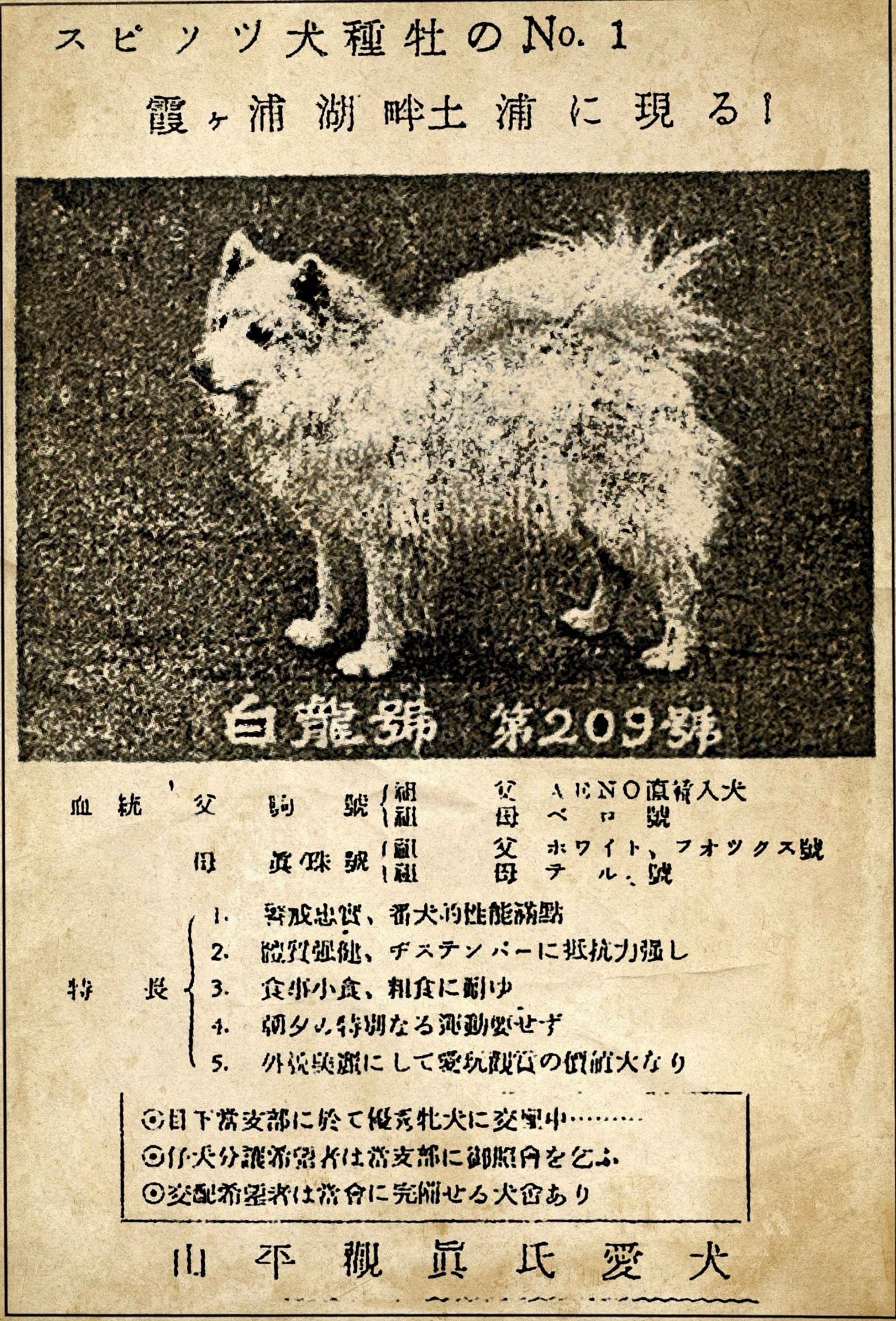
| Japan | 1947.08.06 | Hakuryū-go (White Dragon) |
| Latvia | 2009.11.11 | Houndbrae Akush (UK) |
| Norway | 1975.12.05 | Florence of Rose Garden (Japan) |
| Poland | 1998.06.09 | Rowleys Martini Bianco and Noidens Just White Magic (Sweden) |
| Russia | 1994.06.20 | Odorikko von der Hausruckhöhe (Austria) |
| Slovenia | 1991.05.14 | Mitshubishi Yuki von der Hausruckhöhe (Austria) |
| Sweden | 1973.05.17 | Götter-Mahls Shanshan (Japan) |
| United Kingdom | 1976.06.27 | Alvretens Jicho of Norsken (Sweden) |
| USA | 2019.04 | Entered AKC Foundation Stock Service (multiple earlier imports noted) |
Note: Several countries have unverified or undocumented first entries. These countries include Belgium, Bulgaria, Croatia, Greece, Hungary, and Israel at this stage.
First Imports from Japan: A Timeline of Pioneers
The timeline below documents the earliest confirmed imports of Japanese Spitz from Japan to other countries. This list is vital for tracing the breed’s export history and genetic spread.
Sabina of Moon Light – First Known Import
Animals at Sea: More Than Crew
Animals have long sailed alongside humans. They served not just as workers or sources of fresh provisions. They acted as companions, mascots, and silent witnesses to history. Shipboard cats kept the rats at bay. Dogs offered loyalty in lonely waters. The stories of these animal cremates are quietly woven into maritime life.
A Pup Born for the Waves
One such story began on March 10, 1967. It started with the birth of a small white puppy in Japan: Sabina of Moon Light. Bred by Y. Kaneko, Sabina was a Japanese Spitz. By chance, or perhaps destiny, she became a sailing dog. She grew up among sails and rigging. The scent of salt air was in her coat. The sound of gulls and sea spray was all around her.
Sabina’s journey took her from Japan to the rugged coastline of Norway. She traveled as a Sea dog from Japan. She was accompanied by a Norwegian person working on a ship. She became the first documented Japanese Spitz exported to Europe. She embarked on a life that would, quite literally, set sail across history.
A Silhouette in the Mist
Her white silhouette at sea captivates our imagination. She might be perched at the prow, eyes scanning the waves. Or she may be curled up near a warm stove below deck. In every port, her presence must have turned heads. She was the first of her kind on the continent. She was a little piece of Japan’s snowy hills now afloat on northern waters.

Completing the Circle
Sabina was never entered in conformation shows, nor did she produce puppies. In fact, she was not formally registered in a kennel club until she was nearly ten years old. And yet, her contribution runs deeper. Like the mascots of sailing ships past, Sabina embodied something more symbolic. She was a quiet echo of the Spitz dogs once brought into Japan. These dogs gave rise to the breed itself.
In a way, she completed the circle. A white dog returned across the waves. She carried the legacy of her breed not through ribbons or pedigrees but through presence.
Sabina of Moon Light embarks on a journey. It is a journey not just from Japan to Norway. It is also a journey from obscurity to recognition. And like many animals who’ve sailed before her, she brought with her a story the world didn’t know it needed.
Imports from Japan to Europe (by decade)
1st Decade of Imports (1970–1979)
- 1973.01.21 – Daniel Of Rose Garden → Sweden
- 1973.03.28 – Andoleason of Golden Meadow → Sweden
- 1973.05.17 – Götter-Mahls Shanshan → Sweden
- 1973.07.08 – Gradice of House Cactus → Sweden )
- 1973.08.11 – Athena Leilani of Aloha Land → Sweden
- 1974 – White Pearl of Lone Hill → Sweden
- 1975.04.22 – Albares Carp of Nedory → Sweden (no litters)
- 1975.06.15 – Albert of Lovely → Sweden
- 1975.07.28 – Bullet Fancy of Nedory → Sweden
- 1975.08.05 – I.F. Birdie of Tamana Ariakesow → Sweden
- 1975.08.14 – Dick of Nadeshiko Land → Sweden
- 1975.10.15 – Bilke of Summit Field → Sweden
- 1975.11.05 – Hawk Of Kagetsu Land → Sweden
- 1975.11.05 – Hover of Kagetsu Land → Sweden (
- 1975.11.16 – Adela of Amage → Sweden
- 1975.11.16 – Alice of Amage → Japan
- 1975 – Florence Of Rose Garden → Norway (Reg. No.: 00242/75 / N024275)
- 1977.02.26 – Fujimiland Baby Ramale → Sweden
- 1977.06.14 – White Joanna Of Moon Light → Sweden
- 1979.07.04 – Gaia of Tamana Ariakesow → Sweden
- 1979.07.05 – Hannah of Tamana Ariakesow → Sweden
- 1979.07.05 – Harry of Tamana Ariakesow → Sweden
- 1979.07.13 – Axel of Kobe Manamisow → Sweden
2nd Decade of Imports (1980–1989)
- 1980.12.10 – Alex of Golden Meadow → Sweden
- 1980.12.31 – Fuji Of Oyama Yamamotosow → UK
- 1981.06.28 – Jingle Bell of Harima Takeda → Sweden
- 1981.06.29 – Idol of Nadeshiko Land → Sweden
- 1983.02.04 – Shirayuki of Tokyo Seizansow → UK
- 1983.09.10 – Agree of Senbon Matsubarasow → Sweden
- 1984.11.12 – Take-Mary of Yakohama Takada → Italy
- 1984.11.12 – Take-Oh of Yakohama Takada → Denmark
- 1987.04.12 – Fujiko Of White Kodamasow → Italy
3rd Decade of Imports (1990–1999)
- 1992.06.18 – Masamitsu Of Yokohama Murata → Italy
- 1997.05.24 – Eren Hof Fudziama San Vom Rollenden Haus → Russia
4th Decade of Imports (2000–2009)
- 2000 – Boby of Koza Land JP → UK
- 2002.03.12 – Ostara of M Early Summer → Sweden
- 2002.10.05 – Ryuuchi Of Maruko Nomura → Brazil
- 2003.04.27 – Accel Of God Mount JP → Finland
- 2003.07.24 – Spitz Paradise Angel Mito → Russia
- 2004.03.10 – Prize Of Matsushimosato JP → France
- 2005.10.22 – Kikuchiyo Of Shonan Sumiresow → Italy
- 2005.10.22 – Shonan Sumiresow JP Sayako → Finland
- 2005.11.18 – Jin-Cherry JP Emily → Brazil
- 2005.12.17 – New Tokyo Kennel’s Joddy → Sweden
- 2006.01.25 – Branly Of Casablanca Tomo → Brazil
- 2006.09.02 – Naomi Of Konparu Wakata JP → Finland
- 2007.06.26 – Lapislazuli Of Sylph Sato → Finland
- 2008.05.05 – Spitz Paradise Angel Aki JP → Russia
- 2008.06.05 – Ikar Of Hondasow → Russia
- 2008.11.26 – Orange Hill JP Doris → Finland
5th Decade of Imports (2010–2019)
- 2013.09.12 – Million Steeps White Chouchou → Norway
- 2018.03.16 – Eren Hof Hamahime → Sweden
- 2018.04.06 – Eren Hof Fujiyama → Sweden
6th Decade of Imports (2020-2029)
- 2024.04.06 – Eren Hof Hanku FCI →France
Known Siblings in Japan
- 1975.11.05 – Hadrey Of Kagetsu Land (Japan)
- 1984.11.12 – Take-Chiyo of Yakohama Takada (Japan)
Significance and Preservation
This registry-based and import-focused overview offers a clearer understanding of the Japanese Spitz breed’s international development. It covers its geographic expansion, genetic origins, and patterns of cultural adoption. From Japan, the breed gradually spread into Europe and later into regions such as Australia. Each documented import or registration adds detail to the broader picture of how the breed established itself globally.
The Japanese Spitz Foundation actively compiles and verifies these records in collaboration with breeders, kennel clubs, and archival sources. Contributions such as pedigrees, registration entries, and historical photographs are crucial. They help build a comprehensive and accurate record of the breed’s development across countries. This work supports both historical understanding and practical breeding knowledge.
References
- Finnish Kennel Club. KoiraNet Breeding Database. https://jalostus.kennelliitto.fi/frmEtusivu.aspx?Lang=en&R=262
- Swedish Kennel Club. Hunddata Registry. https://hundar.skk.se/hunddata/Hund_sok.aspx
- Danish Kennel Club. Hundeweb Database. https://www.hundeweb.dk/hundedatabase/
- Norwegian Kennel Club. DogWeb Database. https://www.dogweb.no/hundedatabase/
- Dutch Kennel Club. DutchDogData Database. https://www.dutchdogdata.nl
- Estonian Kennel Union. Kennel Register. https://register.kennelliit.ee/index.php?page=doglist®no=EST%25&lang=EN
- Italian Kennel Club (ENCI). Online Stud Book. https://www.enci.it/libro-genealogico/libro-genealogico-on-line
- Société Centrale Canine (France). LOF Select – Dog Search. https://www.centrale-canine.fr/lofselect/recherche-chien
- Canadian Kennel Club. Stud Book Resources. https://members.ckc.ca/portal/resources/stud-book
- Austrian Kennel Club (ÖKV). Studbook Office. https://www.oekv.at/de/referate/zuchtbuchreferat/
- Lithuanian Cynological Society. E-Kinologija Register. https://e.kinologija.lt
- Czech Spitz Club. Spitz Genealogy Archive. https://archiv.spic.cz/genealogie/index.php