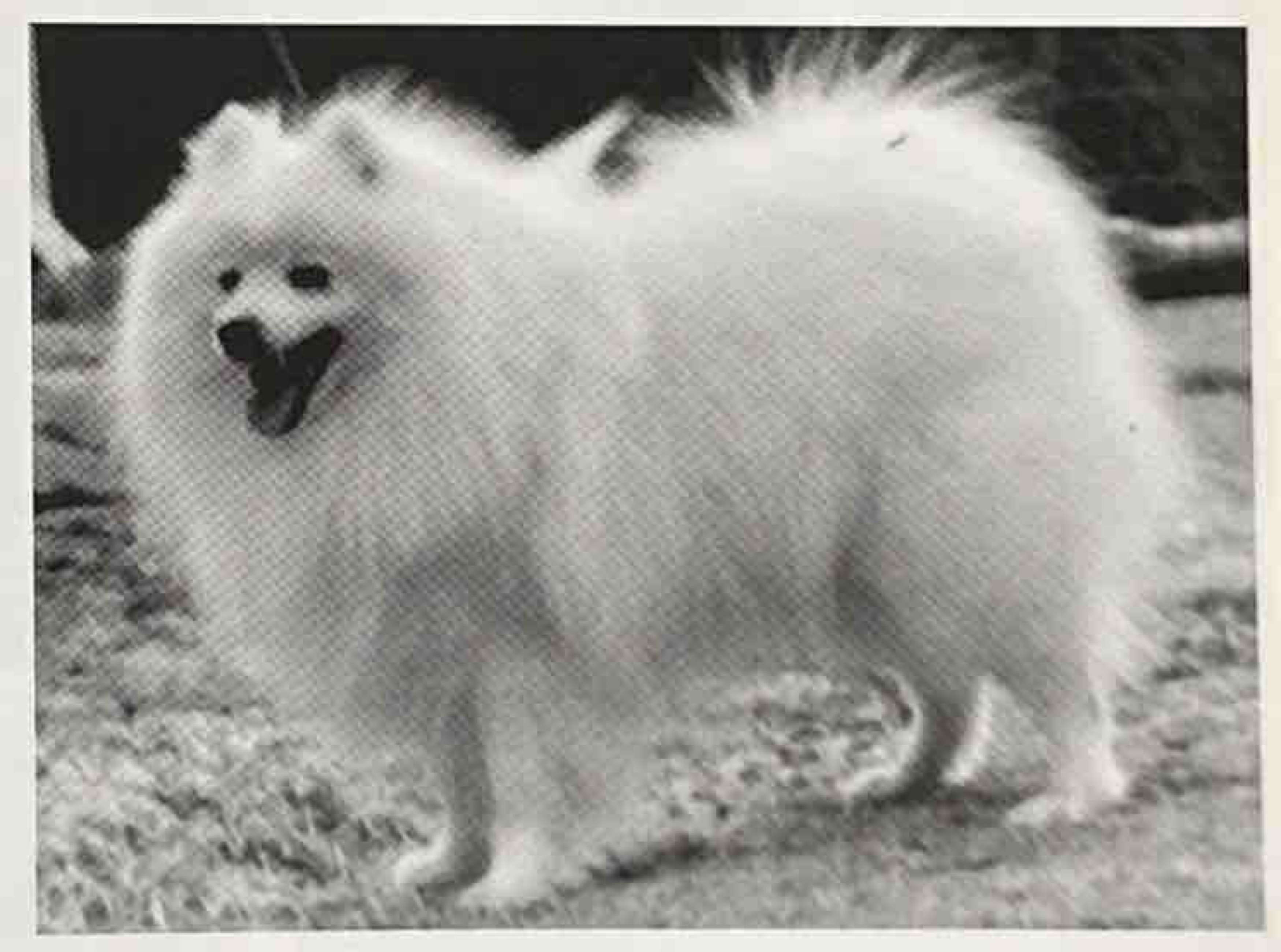
That is what happened to me with CH Musset of Komachisow (小町荘ミュッセ), call name Musset Some dogs appear in a pedigree and quietly change the whole picture.
You start with one name. Then you follow the line a little further back. Then a little further again. And suddenly you realise you are not looking at just one beautiful Japanese Spitz from the past. You are looking at a meeting point of several important Japanese bloodlines.

Gender: Male
Breed: Japanese Spitz
Origin country: Japan
Birthday: November 8, 1991
Breeder: Masako Suzuki
Owner: Shigeru Shiba
MUSSET OF KOMACHISOW Pedigree
Sire: NATSUME OF SAGAMI KUBOTA JP
Dam: KRISHNA OF TSUKISHIMA LAND JP
At first glance, Musset is simply a Japanese champion male. He was born on 8 November 1991, bred by Masako Suzuki under the Komachisow kennel, and owned by Shigeru Shiba. But the more I studied his pedigree, the more interesting he became. His ancestry brings together several well-known Japanese Spitz lines, and because of that, he helps us see how breeders in Japan were building the breed in the late twentieth century.
And honestly, this is the sort of dog I love finding. Not only because he is important, but because he helps connect old Japanese breeding to many pedigrees we still see outside Japan today.
A dog with balance, coat, and light movement
The historical breed material describes Musset in a very pleasing way. He is said to have had a well-balanced body, abundant coat, slender but springy limbs, and a light, agile gait.
I like this description because it feels very complete. It is not only about beauty. It is about outline, coat, movement, and overall balance. In other words, it describes a dog that was not just fluffy and attractive, but properly put together.
That matters. Old Japanese Spitz descriptions often paid close attention to structure and movement, not only to glamour. Musset seems to fit that older ideal very well.
Why his pedigree matters
Musset’s sire was Sagami Kubota Natsume. His dam was Krishna of Space Land.
That already tells us a lot.
He was not coming from an isolated or narrow pedigree. He came from a network of important Japanese kennel lines. In his ancestry we find names linked to Sagami Kubota, Nedory, Lilac Spring, Nadeshiko Land.
To me, this is where Musset becomes especially valuable as a historical dog.
He helps show how Japanese breeders were not always working within one single family line. Often, they were combining several strong domestic lines to preserve breed type, improve quality, and keep the dogs recognisably Japanese Spitz in style and structure.
So Musset is not only one dog. He is also a small map of breeding decisions.
The strong Sagami Kubota influence
The clearest backbone in Musset’s pedigree seems to be the Sagami Kubota line, especially on the sire side.
One key dog in this branch is NSA G. Champion Sagami Kubota Hakuryu. He is described in the historical material as having strong, well-developed limbs, dark eye and nose pigment, and a face with both elegance and spirit.
That is a very telling combination. Good construction, correct pigmentation, and expression are all central to breed identity.
Another related dog, NSA G. Champion Asafuji of Nadeshiko Land, is described as dry, balanced, box-shaped in body, rich in coat, and noble in expression.
When I read these descriptions together, I see a pattern. This branch seems strongly linked to sound structure, balance, strong pigment, and a classic Japanese Spitz look. It is very easy to imagine that Musset inherited part of that foundation.
Nedory: important, even if still a little mysterious
The Nedory line appears in Musset’s pedigree through CH Confidence of Nedory, the dam of Sagami Kubota Hakuryu.
Confidence of Nedory also appears in historical material among dogs used to show traditional “Spitz-like” type. That alone tells us the line was respected and visually important.
At the same time, I want to be careful here.
People often speak about famous lines as if every trait is already proven. In reality, many of those claims come from breeder tradition, not from formal written evidence. So with Nedory, I think the safest conclusion is this: it was clearly an important type influence in the pedigree, but some of the more detailed claims still need stronger documentation.
That is part of responsible history work too. Sometimes the honest answer is not “we know.” Sometimes it is “we strongly suspect, but we still need more proof.”
Lilac Spring brings elegance
Another part of Musset’s pedigree that caught my attention is Lilac Spring.
This line appears through NSA G. Champion Twinkle Jupiter of Lilac Spring. He is described as a “White King Type,” admired for steady quality and known for the strong spirit of his male descendants.
That is such an expressive description. It suggests not only quality, but presence.
A later descendant from this branch, NSA Champion Chiyo Hikari of A.W. Yokohama, is described as slender, upright, clean in presentation, and giving an “urban” impression. I rather love that phrase. It feels precise and stylish at the same time.
Taken together, these descriptions make me think of elegance, refinement, and polish. In Musset’s case, this may help explain part of the lightness and quality noted in his own description.
Nadeshiko Land and classic Japanese Spitz type
The Nadeshiko Land branch also appears several times in Musset’s ancestry, including through Asafuji of Nadeshiko Land, Galaxy of Nadeshiko Land, and Narumi of Nadeshiko Land.
These dogs appear in historical material as examples of representative “Spitz-like” structure. That is important because it places them close to the visual idea of correct breed type at the time.
So even without making dramatic claims, we can say something meaningful: Musset’s pedigree includes lines that were seen as part of the classic Japanese Spitz model.
That gives his pedigree extra weight. It is not just full of names. It is full of names that mattered.
Why Musset matters outside Japan
Musset himself seems to have stayed in Japan. But his line did not stay there. Everyone know
IKAR OF HONDASOW, KOTOHIME OF SHONAN SUMIRESOW, KIKUCHIYO OF SHONAN SHUMIRESOW.
This is one of the reasons I think Musset deserves more attention.
He may not have become famous through one dramatic export story, but his bloodline moved outward through later descendants and became part of European breeding populations. In particular, his influence can be seen in many pedigrees of great dogs.
I find that fascinating, because it shows how breed history often spreads in quiet ways. Not always through one superstar dog. Sometimes through steady, layered movement across generations.
Why I think he matters
For me, Musset matters for three simple reasons.
First, his pedigree brings together several important Japanese lines in one dog. That makes him useful for understanding how breeders were working in Japan at that time.
Second, his descendants help connect Japanese history with European pedigrees. He is one of those bridge dogs who links two worlds.
Third, he gives us continuity. Through Musset, we can still trace the older Japanese kennel lines forward into the modern breed.
And that, to me, is the real pleasure of this kind of research. You begin with one dog, but you end up seeing the architecture of the breed.
Final thought
Musset is not important only because he was a champion.
He is important because his pedigree captures a moment when several strong Japanese Spitz lines were brought together with clear purpose. He helps us see how Japanese breeders preserved type, structure, and style. And through his descendants, he also helps explain how those Japanese bloodlines travelled into the wider world.
For me, that makes him far more than a name on paper.
He is one of those dogs who quietly hold history together.
References
- National Spitz Club (NSC). “Musset.” NSC English archive. Accessed March 14, 2026.
CH Musset of Komachisow. - Okada, Miwako. Spitz Bible. Tokyo: Seibundo Shinkosha Co., Ltd., 2023.
Appendix.