We’ve watched Strela transform from a fearless hunter. She has become the queen of her kitchen kingdom in our “Blind but Brave” series. This is depicted through the stories Blind but Brave: My Strela – Never-a-loser hunter (part I). It then continued with Blind but Brave: Kitchen Queen (part II). While she rules her domain with quiet dignity, I focus on a different mission. I am tracking down the genetic culprit that stole her sight. I delve deeper look into the challenges of PRA-rcd4. This is a type of genetic eye disease that affects dogs. This is an ongoing story and I invite you to learn it together.
Genetic interlude
PRA-rcd4 is inherited in an autosomal recessive manner in dogs. It is a genetic condition passed down to dogs through their parents. It requires two copies of a faulty gene for a dog to show symptoms. This type of inheritance is known as autosomal recessive. Both parents must carry the hidden faulty gene. They must pass it to their offspring for the puppy to be affected. These carriers, who have just one copy of the gene, typically do not show any signs of the disease themselves.
Imagine you’re playing a game where you need to match two cards to win a point. In the case of PRA-rcd4, the pups must inherit two specific “faulty cards” from their parents. These genes are needed for them to be affected by this eye condition. If they inherit only one such card, they become silent carriers without any health issues from the condition. When two carriers have puppies, each puppy has:
- A 25% chance of getting two faulty genes and being affected.
- A 50% chance of being a carrier like its parents.
- A 25% chance of being completely free of the faulty gene.
This is why genetic testing is so crucial for dog breeders. By testing, breeders can find out which dogs carry this faulty gene. Knowing this helps prevent the breeding of two carriers, which reduces the chances of having affected puppies. It’s a bit like checking the cards before playing the game. This helps avoid a risky match that could lead to health problems for the puppies.
Patterns of Autosomal Recessive Inheritance

When we look into family trees to understand autosomal recessive inheritance, we notice some clear patterns:
- Both male and female individuals have an equal chance of showing the trait.
- Only those who have two copies of the gene (homozygous) will show the trait.
- If both parents show the trait, then all their children will also have the trait.
- The children have the trait, but the parents do not. This means both parents carry one copy of the gene. This indicates they are heterozygous.
- If one parent has the trait, a child without the trait still carries one copy of the gene. This is also known as heterozygous.
- It’s also possible for the trait to not show up in one generation but reappear in the next.
It’s important to remember a few things about how genes work:
- Genes come in pairs, and you get one gene from each parent.
- These gene pairs separate during meiosis, which is when sex cells are formed, carrying the chromosomes.
- During fertilization, a sperm cell meets an egg cell. The genes from both parents combine to create the genetic blueprint of the offspring.
- In these pairs, one gene can be dominant over the other, which is recessive. It’s the dominant gene that determines the trait that will be expressed in the individual.
Understanding these principles helps us predict how certain traits might pass down through generations. It informs decisions in contexts like breeding, where avoiding the transmission of undesirable traits is crucial.
But why understanding of this so important and what about Strela?
The genetic test results only confirmed what my heart fought to deny. For days, I moved through our home in tears, watching Strela navigate her new dark world. It’s difficult to see her struggle to navigate around chair legs. She looks for a way out. It is deeply distressing when she accidentally bumps into people because she can’t see them. It’s especially poignant when she lifts her head. She tries to make eye contact like she used to. Now, there is no connection.
Even after the ECVO-specialist’s diagnosis, I grasped at straws of hope. What if Strela’s mutation was a random genetic twist of fate? Could it be a spontaneous change rather than an inherited defect? Such mutations can occur—nature’s unexpected rewrites in the genetic code. If her case was isolated, the implications for the breed would be minimal.
But science rarely deals in comfortable maybes. The EVG genetic lab’s confirmation of PRA-rcd4 demanded action. My kitchen table transformed into a research station, covered with pedigree charts mapping bloodlines like a detective’s case board. Each line drawn between names carried weight—possible carriers, potential affected siblings. What started as one dog’s diagnosis became a mission to protect future generations.
Then, I stepped into researcher mode. I considered all the information I told you above. I carefully drew a pedigree chart to find out which other dogs might need testing. As I drew, I realized I had several related dogs. I sketched them all on a piece of paper to plan the next steps.

With Strela’s parents, Hiro and Yasya, having crossed the rainbow bridge, the genetic trail led to her siblings. I started with the three I had at home: Saty, Thor, and Tara.
Things are moving at a leisurely pace here. This is because I don’t have the luxury of a dedicated research grant or lab. Instead, I’m spinning quite a few plates. I’m managing the kennel and attending to endless paperwork. I occasionally enjoy a cuppa. All of these activities distract me from my genetic detective work!
To ensure objectivity, I designed a double-blind approach with different genetic labs and ECVO-certified specialists. Dogs would undergo both genetic testing for PRA-rcd4. They would also be examined by an ECVO-certified specialist. Neither the ophthalmologist nor the lab would know the dogs’ relationships or test results. Starting with Saty, Thor, and Tara, we proceeded as if each was an isolated case.
The results aligned with chilling precision. Both DNA tests and specialist examinations independently identified Saty and Thor as affected. Tara’s carrier status emerged through genetics, while her eyes remained clear. This blind validation eliminated any confirmation bias, making the pattern of inheritance undeniable.
The pattern was too clear, too consistent with inherited PRA-rcd4. This wasn’t a random mutation but a hidden genetic current flowing through family lines, demanding our attention and action. I have to accept the truth and move ahead.
What can be done?
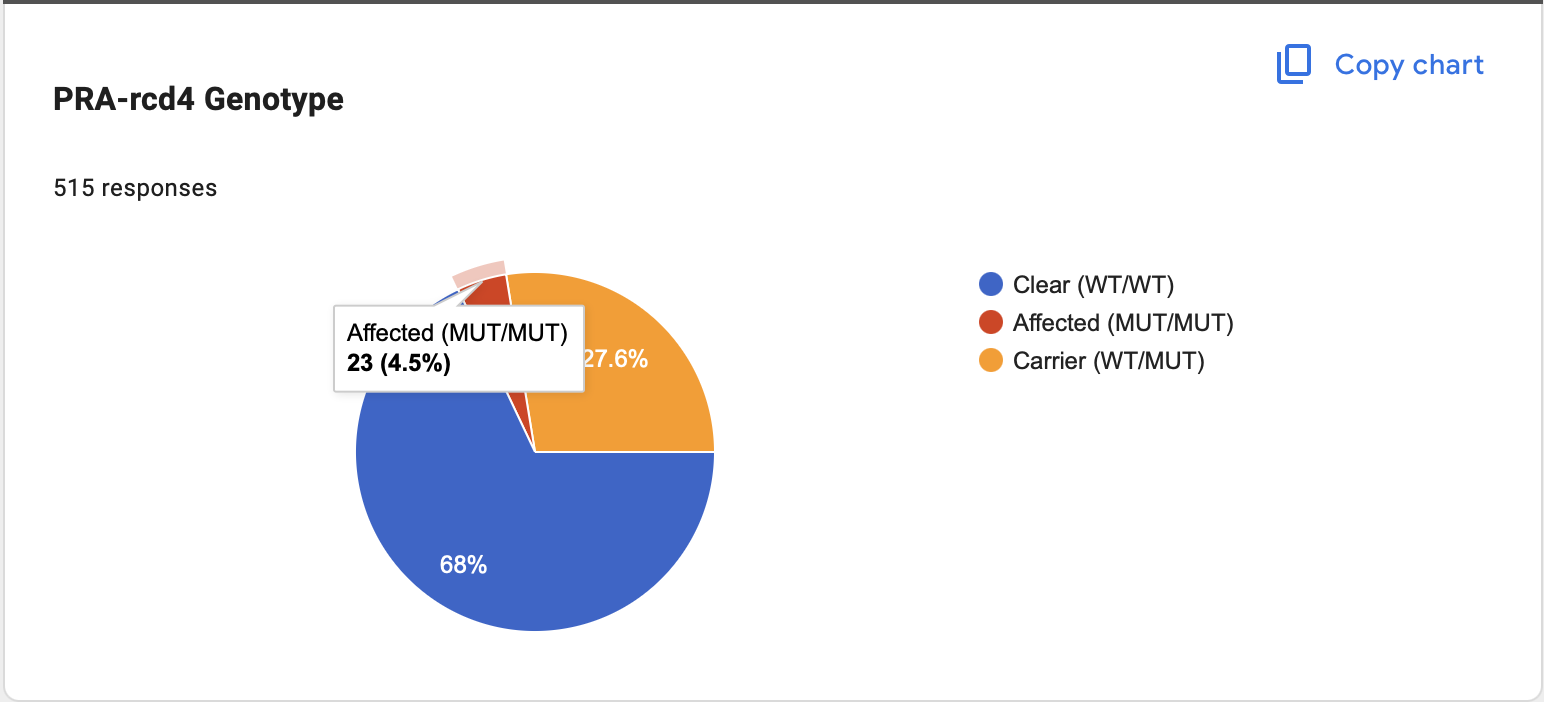
Prevention lies within our grasp. With reliable testing now available, we can identify carriers and affected dogs before they enter breeding programs. But individual testing isn’t enough—we need population-wide screening to understand PRA-rcd4‘s prevalence in Japanese Spitz bloodlines.
This realization led me to establishing the Japanese Spitz Foundation, designed to tackle three critical challenges:
- Strategic Testing: Identifying high-priority bloodlines for testing through pedigree analysis, maximizing impact while managing costs.
- Lab Partnerships: Negotiating affordable testing rates for breed-specific screening programs, making prevention accessible to all breeders.
- Resource Pool: Creating a shared fund and knowledge base for cross-border genetic research, uniting breeders worldwide in this mission.
My three confirmed cases of affected dogs offer statistical groundwork. But, we need broader data to map this condition’s spread through our breed. Each tested dog adds another piece to the puzzle, helping us protect future generations from inherited blindness.
Time works against us—every breeding decision made without genetic insight risks passing PRA-rcd4 to new puppies. But together, through strategic testing and shared resources, we can gradually low this mutation in our breeding lines.
But I have a good news also. Sometimes the smallest pebble creates the largest ripples. Within months of Strela’s test results, I noticed a subtle but significant change. The EVG genetic laboratory added PRA-rcd4 to their Japanese Spitz breed list. Then another lab which I ask for test followed suit. And another.
This quiet revolution spread through market forces alone. Labs watch their competitors, updating their testing panels to stay competitive. Without waiting for official studies or breed club guidelines, they’ve made PRA-rcd4 testing accessible to every Japanese Spitz breeder.
The implications are profound. Now, any breeder researching genetic tests will find PRA-rcd4 listed for our breed. They can screen their dogs before breeding, preventing affected puppies before they’re conceived. This practical change might spread faster than the mutation itself. It’s a race between information and inheritance. We finally have a chance of winning this race.
It’s beautifully ironic. The competitive instincts that drive labs to expand their test panels are also helping us protect our breed. No official proclamations needed, just market forces working in our favor. One test, one dog, one family line at a time, we’re building a safer future for Japanese Spitz.
What next?
Finding one mutation feels like discovering a single star in a vast genetic sky. With over 17 known PRA variants lurking in different genes, a clear PRA-rcd4 test doesn’t guarantee a future without blindness. We’re searching for needles in a DNA haystack, and some needles might still be unknown.
Moreover we need are the dogs that tell a different story—those with confirmed PRA by ophthalmology but negative for PRA-rcd4. These are our genetic detectives, potentially harboring yet-undiscovered mutations. Each one could lead us to another variant affecting our breed.
The traditional testing approach follows a predictable pattern. First, an ophthalmology check is done at 1-2 years. Next, it is repeated at age 8-10. That’s like watching a slow-motion game of genetic roulette.
This challenge mirrors Strela’s own journey through darkness. We take careful steps onward. We test each move and adapt our approach based on what we find. We can’t afford to wait for dogs to grow old before discovering new mutations. The cost in both money and time is significant, but the cost of ignorance is far greater.
The breakthrough came unexpectedly. A conversation with a geneticist friend revealed the game-changer: Next-Generation Sequencing (NGS). NGS does not hunt mutations one by one. Instead, it screens for over 300 known variants at the same time. It also calculates the DNA-based Coefficient of Inbreeding (COI). The cost? Just 5-6 times a standard PRA-rcd4 test—a bargain for comprehensive genetic mapping.
This technology can transform our approach from searching for a specific needle to mapping the entire haystack. Each test could reveal PRA variants. It could also uncover hundreds of other potential genetic markers hiding beneath those fluffy white coats.
I’ve already submitted samples from my dogs, joining the queue of early adopters. While we wait for results, the Japanese Spitz Foundation (JSF) is laying groundwork for the future. We’re integrating global pedigree databases to find genetically distant lines—the dogs most likely to reveal our breed’s true genetic diversity.
This strategic approach matters. By testing the most genetically diverse dogs first, we maximize our chances of finding hidden mutations. Each result builds our understanding, helping focus future testing where it matters most. Through NGS technology and smart sampling, we’re not just looking for problems—we’re mapping the genetic future of our breed.