There are photographs Spitz named Silver Prince that sit quietly in an archive for years. And then, one day, they start asking questions.
This one had been doing exactly that.

At first glance, it looked almost solvable: a pre-war Japanese advertisement, a beautiful actress, a white Spitz named Silver Prince, and enough text to offer clues without quite giving the answer away. It was the kind of fragment that gives just enough confidence to keep going, and just enough resistance to keep you stuck.
For a long time, this image refused to resolve.
Until it didn’t.
The moment everything shifted
The breakthrough came from something almost embarrassingly small.
Two kanji.
Or more precisely, their order.
The title on the image reads 日向葵娘. At first glance, it looks close enough to 向日葵娘 (Himawari Musume — Sunflower Girl). But in Japanese, “close enough” is rarely enough. Shift one element, preserve an unusual form, and suddenly you are not looking at quite the same thing anymore.
Once the title was corrected — or rather, once it was understood as a mistaken or non-standard form pointing back to Himawari Musume — everything fell into place.
The photograph was no longer just an attractive but mysterious promotional image. It was tied to a specific film, a specific year, and a specific cultural moment.
A dog with a name
The caption begins with 仲よし — Nakayoshi, meaning “good friends” or “close companions”.
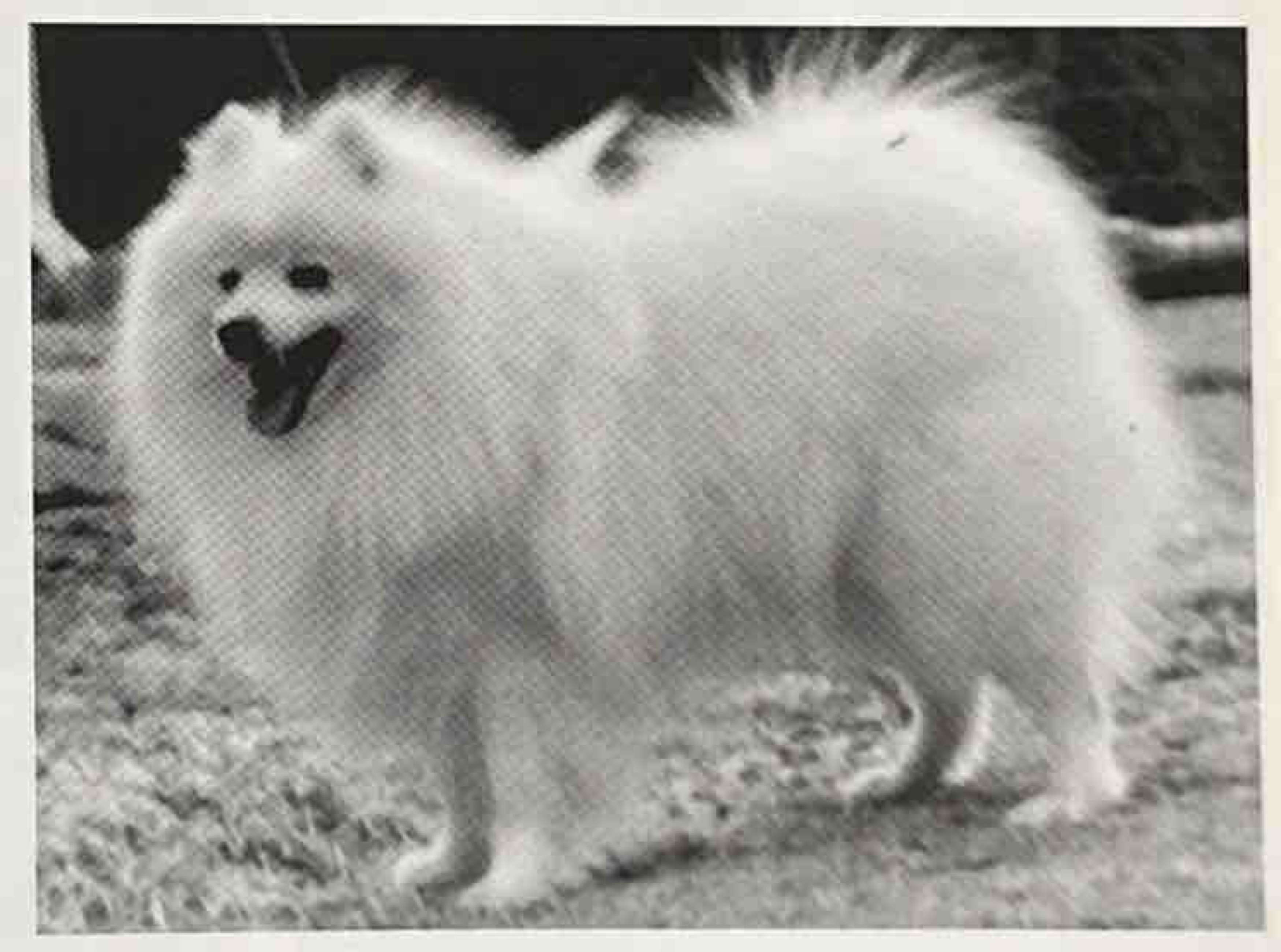
Then it continues with the real revelation: Silver Prince-gō, the beloved dog of Mr. Kiyonosuke Awata, together with actress Michiko Kuwano, who starred in the film Himawari Musume.
That one line quietly changes the entire meaning of the image.
Because the dog is not symbolic, decorative, or anonymous. He has a name: Silver Prince. He has an owner: Kiyonosuke Awata (粟田清之助). And, most importantly, he appeared in a film released in Shōwa 14 (1939).
There may also be an additional clue to Silver Prince’s identity. In a separate advertisement dated Shōwa 14 (1939), a dog named Silver Prince is described as a superior imported Spitz breed, a male aged 2 years and 6 months, with a pure white coat. The same notice gives him a notable show record: in Shōwa 13 (1938) he received the Highest Distinguished Honour Award at the Ueno National Defense Exposition; on 14 May 1939 he won the Highest Prize Award and Excellence Cup at the Dai-Nippon Aikoku Grand Exhibition; and on 21 May 1939 he took First Place Excellent Award and Excellence Cup at the All-Japan General Livestock Grand Exhibition. It is not yet possible to prove that this prize-winning Silver Prince is the same dog as the one shown with Michiko Kuwano. But the date, the name, the white coat, and the general profile make the possibility difficult to ignore.
If this identification is correct, the photograph becomes even more interesting. We would not be looking simply at a named white spitz-type dog in a film advertisement, but potentially at a dog who was already visible in the exhibition world as an imported and decorated Spitz before the post-war breed narrative had properly begun.
Before the “beginning” of the breed
This is where the story becomes genuinely interesting.
Because 1939 is not simply old. It is earlier than the timeline we usually tell.
Most narratives about the Japanese Spitz place its real development in the post-war period. The rapid expansion in popularity, the spread across Japan, and the organised efforts to shape and stabilise the breed all belong, in the usual telling, to the late 1940s and 1950s. Japanese historical sources themselves often describe the white Spitz as something that became especially visible after the war, when it began to appear in homes, shops, exhibitions, and eventually across the country.
Which makes this image slightly inconvenient in the best possible way.
Because here we are, in 1939, looking at a clearly defined white spitz-type dog who is not hidden in the background of history. He is named, identified, associated with a known owner, and visible enough to appear in cinema-related promotion. In other words, he is not a vague “type” reconstructed backwards from later breeding history. He is a real, public dog, standing in front of us before the official history of the breed is usually said to begin.
Michiko Kuwano — and a very modern moment
The human side of the image matters just as much.
Michiko Kuwano was one of the notable pre-war stars of Japanese cinema: elegant, modern, and unmistakably part of the urban cultural world of the 1930s. Her public image carried a particular kind of refinement. She was fashionable without seeming artificial, contemporary without seeming frivolous.
And in this photograph, she is simply sitting with a dog.
There is no exaggerated theatrical gesture, no dramatic staging, no attempt to force sentiment. Just proximity. “Good friends.”
That simplicity may be precisely why the image works so well. It presents not spectacle, but companionship. And in doing so, it gives us something unexpectedly valuable: a glimpse of how such a dog could already function in public imagination before the later breed narrative was fully formed.
What the photograph is really doing
This is not just a film still preserved by chance. It is an advertisement, and that matters.
It was made to communicate something specific. It links the actress, the dog, and the film into a single, readable image of warmth, charm, and modern intimacy. The dog is not there only as an accessory. He helps produce the mood of the piece, softens the star image, and introduces a note of domestic familiarity into an otherwise carefully constructed public persona.
Even the use of 號 (gō) in the dog’s name is telling. In this context, it suggests a formal, pedigree-style naming convention, rather than a casual household nickname. That, in turn, fits well with the possibility that Silver Prince was a dog already known in exhibition or breeding circles, presented with a certain status rather than included purely for decorative effect.
So what was Silver Prince?
That question naturally follows, and it is the one that requires the most caution.
Was he already a Japanese Spitz in the strict modern sense? That cannot be stated with certainty from this image alone. The later breed standard, organised breeding structures, and retrospective historical accounts belong to a more developed stage.
But the photograph does allow us to say something important. Silver Prince was clearly a white spitz-type dog of a recognisable kind. He was privately owned, publicly named, and culturally visible. He was not merely part of a private household world but had entered the sphere of media and representation. That places him in a transitional space: not yet fully contained within the later standardised breed narrative, but already present in the world from which that narrative would emerge.
Why this matters
Not because it rewrites history in one dramatic stroke.
It matters because it complicates history in a useful and honest way.
This photograph does not prove that the Japanese Spitz, as later defined, formally existed in 1939. But it does show that the visual and cultural presence of this kind of white spitz dog predates the cleaner post-war narrative. It shows that such dogs were already visible, already meaningful, and already associated with modernity, affection, and public appeal.
That is a small finding, but not a trivial one.
Breed history is often told backwards, with later definitions imposed too neatly on earlier fragments. What makes this image valuable is precisely that it resists neatness. It reminds us that before there was a settled breed story, there were already dogs, people, images, and moments that made that story possible.
A small correction — and a door opens
There is something slightly humbling in that.
All of this began with a title that did not quite read correctly. A detail that looked close enough until it didn’t. Two kanji that refused to sit in the expected order.
And then suddenly the photograph opened: a film, a year, an actress, an owner, a named dog.
A white Spitz standing in 1939, before the official beginning, waiting patiently in an archive until someone finally asked the right question.