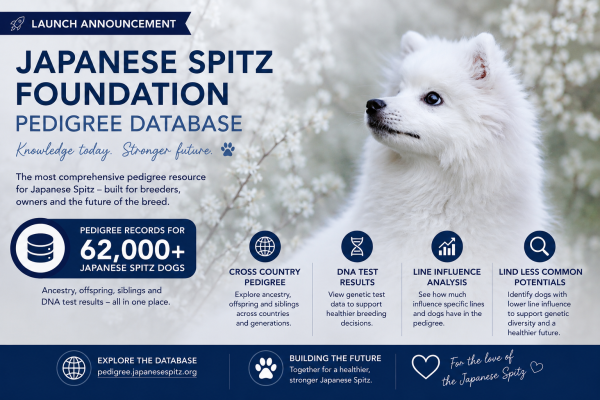
The first version of the Japanese Spitz Foundation international pedigree database is now online.
After a considerable amount of collecting, importing, matching names and discovering just how creatively the same dog can be recorded in different countries, we now have more than 62,000 Japanese Spitz connected in one database. You can explore pedigrees across generations, find siblings and offspring, and see DNA test results where they are available.
But this is very much a first release, not a finished database.
What you can look up
Every dog has its own page, and every page shows the same four things: a four-generation pedigree, the dog’s own offspring grouped by mate, its full siblings, and any DNA test results on record, shown exactly as recorded.
Some of the dogs in there are the ones this site has been writing about for years. NORSKEN AMIDA, Australia’s first Japanese Spitz, has nineteen offspring recorded. HARRY OF TAMANA ARIAKESOW has twenty. ALCYON OF PORT MASUDA, whose pedigree took a small detective story to untangle, is there too, and so is MUSSET OF KOMACHISOW.
Names are the hard part. The same dog is often recorded differently in different national registers, and sometimes the register and the pedigree document disagree with each other. Where sources conflict, the database follows a fixed order: the studbook of the country of origin first, then the pedigree as scanned, then the studbook of the country where the dog is registered now. Accents are optional when you search — tahtihovin finds TÄHTIHOVIN, and the other way round. If a name you know is not there, try another spelling before concluding the dog is missing.
Find your dogs — and tell me what is wrong
There are dogs missing. There are missing parents and offspring. There are dogs recorded under slightly different names in different national studbooks. There will be duplicates and mistakes, and I am reasonably certain the pedigrees still contain a few surprises waiting for me. With 62,000+ dogs, finding all of them myself could take a while.
This is where breeders and owners can help enormously. You know your own dogs and lines better than I do. Have a look at the pedigree database, find your dogs and check their information and pedigrees.
If a dog is missing, something is incorrect, an offspring needs to be added, or you have information that can make a record more complete, please send it through the correction form.
Corrections are not an inconvenience — they are exactly what I expect at this stage. A pedigree database becomes useful not because it contains a very large number of dogs, but because the information connecting those dogs becomes increasingly complete and reliable.
PRA-rcd4 testing at the end of August 2026
Alongside the pedigree work, we are continuing to collect PRA-rcd4 DNA test results for Japanese Spitz. At the end of the first quarter of 2026 we had collected 507 results. By the end of August that number has reached 530.
31 August 2026 picture is:

- Clear (WT/WT): 68.1%
- Carrier (WT/MUT): 27.5%
- Affected (MUT/MUT): 23 dogs — 4.3%
Interestingly, another 23 results have been added since the previous update, but the overall proportions have changed very little. That is useful information in itself. The full history and what each result means are on the PRA-rcd4 statistics page.
This time there is no report to download. Every result we have collected is now live in the pedigree database, on the page of the dog it belongs to. Look a dog up and its status sits with the rest of its record — listed as PRA-rcd4-C2orf71, in the same Clear / Carrier / Affected wording used here, alongside whatever other tests are on file. Where a parent has been tested, that result appears in the pedigree as well, so you can see how a mating looks without holding a list in one hand and a pedigree chart in the other.
The purpose of collecting these results is not to produce frightening red sections on pie charts. It is to understand what is actually present in the breed.
The same applies to pedigrees. A DNA result tells us something about an individual dog. A pedigree tells us how dogs are connected. Until now those two things lived in separate documents. Now that they sit in the same place, we can start looking at them together, across countries and across generations — and that is where the data becomes much more interesting. And hopefully much more useful.
What comes next
There is still a great deal to clean up and add to the pedigree database, and there are many more genetic results we would like to collect. But at least we now have somewhere to put it all.
The next stage is improving the quality and completeness of what is there, and developing better ways to look at the population behind the individual pedigrees.
For now, please explore the database, check the dogs and families you know, and send me the things that need correcting.
There are 62,000+ dogs in there. I am under no illusion that we got every one of them right on the first attempt.