On 4 September 2026, alongside the European Dog Show in Sweden, the Swedish Japanese Spitz Club organised and hosted an international breeders’ roundtable, bringing together Japanese Spitz breeders from several countries.
The idea was fairly simple: share what is actually happening with the breed in different countries.
For couple hours the conversation moved through population size, genetic diversity, health and DNA testing, fertility, natural matings, breed type, declining registrations and the practical difficulties of breeding within increasingly small national populations.
There were different experiences and, occasionally, quite different opinions.
Which was rather the point.
For those who were not there, here are the main subjects that came out of the discussion.
One breed, many countries, many of the same ancestors
Population and genetic diversity occupied a large part of the meeting.
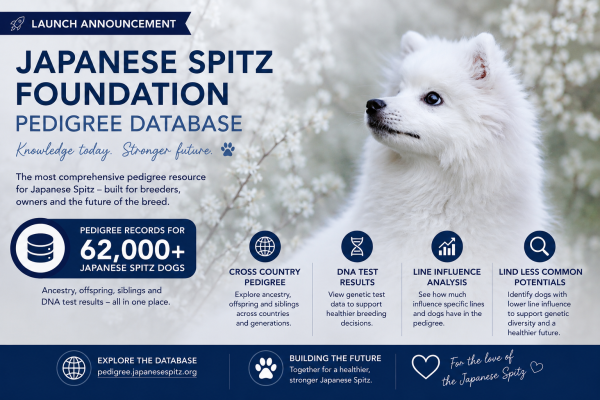
The international Japanese Spitz database now contains more than 62,000 dogs. It is already large enough to reveal patterns that are difficult to see in ordinary three-generation pedigrees, although it is still far from complete.
Many dogs are missing, and records from some countries are much better represented than others. But the database already serves one of its main purposes: allowing us to look beyond national registries and see the Japanese Spitz as one international population.
And the further back we follow the pedigrees, the clearer one thing becomes: geographical distance does not necessarily mean genetic distance.
Only 55 Japanese Spitz were originally exported from Japan to establish the breed population across the rest of the world. Even that number overstates the genetic diversity of the foundation population, because some of those dogs were full or half siblings.
Over the generations, their descendants have been combined in many different ways, and the contribution of individual foundation dogs to modern pedigrees varies considerably. But when those pedigrees are followed back to their origins, the number of genuinely distinct bloodlines behind the Japanese Spitz population outside Japan is remarkably small.
This is why importing a dog from another European country, Australia or New Zealand does not automatically mean introducing different foundation blood. A pedigree may look quite different over three generations — and come with a different kennel-club registration number and several thousand kilometres of travel — while further back many of the same ancestors appear again.
Sometimes a very international-looking pedigree turns out to be a family reunion with unusually complicated travel arrangements.
This led to an important part of the discussion: before looking only for new genetic diversity, we should also understand and make better use of the diversity that still exists within the current population.
Some foundation lines and their descendants have been used extensively, while others were used very little and have almost disappeared from modern breeding. Less-used descendants, siblings of well-known dogs and dogs that never entered the show ring may therefore be particularly worth finding and considering.
The most useful dog for a particular breeding programme may not necessarily be the one with the longest list of titles.
Looking further back in Japanese Spitz pedigrees
Several examples during the meeting showed why the number of generations used for pedigree analysis matters.
A mating that appears almost unrelated over three or five generations can look quite different when older generations are included. Ancestors imported decades ago may still make a substantial contribution to dogs being bred today.
This is one reason the international Japanese Spitz database is being developed beyond a simple pedigree search.
The aim is eventually to provide practical tools for breeders: deeper pedigree analysis, information about the contribution of particular ancestors and lines, health-test information and hypothetical mating reports that can highlight relevant results for a proposed combination.
But a database is only as useful as the information inside it.
Breeders were therefore asked to check whether their current dogs, older dogs and litters are included and to submit missing records. A litter submission option is available because entering six puppies separately is an excellent way to discover that enthusiasm for population genetics has limits.
Questions about how to use the database are equally useful. If something is difficult to understand, it probably needs a better explanation rather than a more determined user. So a FAQ page will be created as more questions come.
DNA testing: useful information, not the whole dog
Genetic testing produced one of the longer discussions of the afternoon.
In particular, participants discussed what should happen when a healthy dog is identified as a carrier of a tested genetic variant.
One concern was that automatically removing all carriers / affected from breeding can unnecessarily reduce an already limited gene pool. Where the inheritance of a condition is understood and a carrier can be appropriately paired with a suitable tested dog under the relevant breeding rules, carrier status can be managed as part of a breeding decision rather than treated as the definition of the dog.
Not everybody around the table approached the question in exactly the same way. Some breeders prefer not to produce carriers at all.
The broader point was more important than reaching complete agreement.
Health testing and population diversity cannot be considered separately.
A Japanese Spitz is not one laboratory result with a coat attached.
Testing gives breeders information. The difficult part is deciding how to use that information without creating another problem while trying to solve the first one.
Health-test results are also being incorporated into the international database, with the intention that they can eventually form part of its hypothetical mating and breeding tools.
Japanese Spitz health beyond DNA tests
From DNA testing, the conversation moved naturally to the much larger group of health problems for which there is no convenient DNA result.
The discussion included allergies and autoimmune disease, gastrointestinal problems, dogs that are persistently difficult to feed or frequently vomit, Addison’s and Cushing’s disease, kidney problems, epilepsy, fertility, small litters and empty bitches. Patellas, eyes, teeth and structural problems were also discussed.
For some conditions there may be a hereditary component but no identified mutation in the Japanese Spitz. Others are complex or multifactorial. And in some areas there is simply not enough information yet to know what patterns exist within the breed.
That uncertainty is precisely why these conditions should not disappear from the conversation.
The recently updated Guide to Japanese Spitz Health and Genetic Mutations brings together the health problems and genetic mutations currently known or reported in the breed. It includes the mutations for which DNA testing is available, but deliberately does not stop there. It also covers other health conditions that need to be watched and recorded even where there is currently no validated DNA test, no confirmed breed-specific mutation or simply not enough information to draw firm conclusions.
It is best understood as a developing overview of Japanese Spitz health rather than a final list. As more information becomes available through clinical cases, breeders and owners, veterinary research and genetic testing, that picture will inevitably change.
This was very much in line with the discussion around the table.
DNA testing tells us useful things about what we can currently test.
It does not make everything else disappear.
A dog can have an impressive collection of “clear” DNA results and still have allergies, chronic digestive problems, poor fertility or relatives repeatedly affected by the same condition.
So breeders still need the less glamorous form of health investigation: share own experience and asking questions.
What health problems occur in the family? How old were the relatives? What did they die from? Is the dog persistently difficult to feed? Have close relatives had behaviour issues or kidney disease? How is fertility in the family? Are the same problems appearing repeatedly among related dogs?
And beyond disease, what is the dog actually like to live with? How is its temperament?
Most of this will never fit neatly into a laboratory certificate.
It requires breeders and owners to follow dogs throughout their lives and to share information when something goes wrong, not only when everything went according to plan.
As was said during the meeting: if we do not ask the questions, we do not know what we are breeding.
Fertility — and occasionally privacy
Fertility deserved a discussion of its own.
Breeders from different countries reported small litters, unsuccessful matings, irregular seasons and difficulties getting bitches pregnant.
Possible connections with population size and inbreeding were discussed, but no simple cause was established. The conversation also moved towards something considerably less theoretical: the way natural matings are managed.
Several experienced breeders felt that there is an increasing tendency to rely heavily on progesterone results and predetermined dates while paying less attention to the behaviour of the dogs themselves.
Examples were given of bitches mating considerably later than expected and males refusing to perform in unfamiliar surroundings, indoors or while several humans watched proceedings with great professional interest.
Nobody suggested abandoning progesterone testing.
The rather more modest suggestion was to use the numbers and watch the dogs.
Some Japanese Spitz males, it appears, have read the breeding programme but would still appreciate a little privacy.
Declining Japanese Spitz registration numbers
The health and fertility discussions also sit within a wider concern: in several countries, the Japanese Spitz breeding population is becoming smaller.
Sweden was discussed as one example. During the meeting, annual registrations were said to have been 250+ puppies per year around 2008 and to have fallen to approximately 90 in 2025.
Norway was mentioned as having 83 puppies born. Finland 81 in 2025.
The exact figures aside, the concern was shared: once national Japanese Spitz populations become very small, thinking purely within national borders becomes increasingly unrealistic.
A country with only a handful of active kennels cannot function as an isolated breeding population in any meaningful sense.
France with 400+ puppies in 2025 and Poland raised population were among the populations specifically mentioned as important to understand and connect with better. Japanese Spitz breeding has changed geographically, and the flow of pedigree and health information has not always changed with it.
Future imports from Japan
New imports from Japan were naturally part of the population discussion.
One idea raised at the meeting was that future imports might be more useful if approached cooperatively rather than as a series of unrelated decisions by individual kennels.
Importing one dog and subsequently using that dog very widely can simply create another popular-sire effect.
A coordinated effort involving several unrelated or less-related dogs, imported within a relatively short period and then used thoughtfully across different breeding populations, could potentially have a very different impact.
This is not an established programme or decision. It was an idea discussed at the meeting, with plenty of practical questions still attached.
But the principle was interesting: if the population problem is international, perhaps at least some of the solutions should be international too.
Before looking for entirely new blood, however, there is also the question of how well we are using what we already have.
The dogs nobody notices
Another very practical discussion concerned breeding dogs outside the usual breeding and show population.
There may be perfectly useful males living quietly in family homes that effectively disappear from the breeding population because nobody knows they exist or nobody thinks to ask about them.
The traditional pattern is usually for the bitch owner to search for a stud dog. Several participants suggested that information could travel in the opposite direction as well.
Breeders and stud-dog owners who notice an interesting pedigree could contact the breeder of a bitch and suggest a dog that might otherwise never have been considered.
This is particularly relevant when trying to preserve less-used bloodlines.
A male does not stop having useful genes because he has never learned to stand attractively beside a trophy.
Costs and practical arrangements around matings were discussed as well. Where a particular combination may be genuinely useful to the breed, greater cooperation between owners could sometimes make combinations possible that would otherwise never happen.
Structure, breed type and the whole dog
With all the discussion about coefficients, pedigrees and genetic tests, there was also a reminder that the Japanese Spitz remains an actual dog.
Participants raised concerns about variation in breed type and proportions, including long backs and loins, short ribcages, narrow or insufficient chests, croups and hocks, lack of chin, small teeth and dental problems.
But the discussion went beyond identifying individual faults. We rarely talk about how the different anatomical features we select for may be connected, or what happens elsewhere when one particular feature is gradually pushed further.
Small teeth were one example. Dental problems are not unusual in the breed, but how often do we consider teeth together with the size and structure of the jaws, rather than as an isolated detail?
Similar questions can be asked about other features we associate with Japanese Spitz type. How large should the eyes become before the expression we find attractive begins to come with disadvantages? If we favour an increasingly tight or heavily carried tail, should we also be looking more carefully at the anatomy underneath it — the croup, pelvis and spine? And when we select for a particular outline, are we paying enough attention to the ribcage, proportions and structure hidden beneath the coat?
These are questions, not conclusions. The meeting did not establish that one feature causes another, and the relationships between anatomy, health and function are rarely that obligingly simple.
But they are questions worth asking.
Breed type is not a collection of independent details that can each be selected or exaggerated without considering the rest of the dog. Teeth belong to jaws. Eyes sit in skulls. Tails are attached to spines. Ribcages have to contain rather important things.
Preserving genetic diversity therefore does not mean abandoning structure, function or breed type. Equally, selecting for breed type should not mean repeatedly narrowing the population around whichever dogs happen to be winning at the moment, or considering appearance separately from anatomy and wellbeing.
Population, health, temperament, structure and breed type all have to be considered together.
Breeding would undoubtedly be easier if there were only one thing to think about. Unfortunately, nobody appears to have informed the dogs.
The Japanese Spitz still has to work as a whole dog. The coat merely makes it slightly easier to forget what is underneath.
Sharing Japanese Spitz health and breeding information between countries
Towards the end of the meeting, attention turned from individual breeding decisions to the information collected at population level.
Sweden, Norway and Finland have breed-specific strategy documents or systems for following developments within the Japanese Spitz population.
One suggestion was to translate the new Swedish RAS into English so that information and priorities could be compared internationally.
Finland also described the use of repeated questionnaires for breeders and puppy owners. Asking comparable questions at intervals makes it possible to see whether a problem is becoming more or less common instead of relying entirely on memory and impressions.
This connects directly with the earlier discussion about health problems for which there is no DNA test.
If several countries collect comparable information about allergies, epilepsy, kidney disease, fertility, longevity, causes of death and other health issues, patterns may become visible that are almost impossible to recognise within one small national population.
Sharing the questions themselves could therefore be a useful first step.
The dogs, after all, have been crossing our borders for decades. The information might as well follow them.
What came out of the roundtable?
There were no new international breeding rules at the end of the meeting.
Probably just as well.
There were, however, several practical directions worth continuing:
- maintain the international Japanese Spitz database and add missing dogs and litters;
- look further back in pedigrees and identify less-used bloodlines;
- use DNA testing as one part of breeding decisions rather than the whole definition of health;
- continue collecting information about diseases and health problems for which no simple genetic test exists;
- share long-term health, fertility and cause-of-death information between breeders and countries;
- find potentially valuable breeding dogs outside the usual show population;
- compare national health surveys and breeding-strategy documents;
- use the Japanese Spitz History Facebook group as a communication channel where breeders from different countries, including growing or relatively isolated Japanese Spitz populations, can exchange information;
- establish a regular breeders’ roundtable, preferably online, so that more breeders from different countries can take part;
- and continue discussing whether future imports from Japan could be coordinated internationally.
The Japanese Spitz Foundation and the international database project will also need a sustainable way to cover their running costs. Support from breed clubs and private donations is welcome. We also discussed the possibility of eventually offering paid litter or puppy advertising, with the income helping to keep the pedigree and breeding tools freely available.
Again, these were discussions and ideas, not resolutions.
A couple of hours around one table were never going to solve the future of the Japanese Spitz.
What they did provide was a chance for breeders from different countries to compare what they are actually seeing — including the uncomfortable things, the uncertain things and the things for which nobody yet has a tidy answer.
For a breed spread across half the world but descending from many of the same dogs, that seems a useful place to start.
We have rather more dogs in common than our passports suggest
and you are welcome to read updated Breeding Strategy from Sweden Japanese Spitz club