The first registered Japanese Spitz by the Japan Kennel Club was 白龍號 – Hakuryū-go (White Dragon). Koma-go sired him, and Shinju-go was his dam. He was whelped on August 6, 1947.
Known Information
According [1], Hakuryu was the number 1 Japanese Spitz in the Book of Origins of the Japan Kennel Club. Hakuryu’s name means “White Dragon”. The owner’s name was Tamotsu Sakamoto. It has been proven that he was born on August 6th, 1947, to sire Koma and dam Shinju.
The similar information we can see in [2] “The first Japanese Spitz registered by Japan Kennel Club was Hakuryu-go (White Dragon) sired by Koma-go our of Shinju-go and whelped August 6, 1947”
Information behind of scene
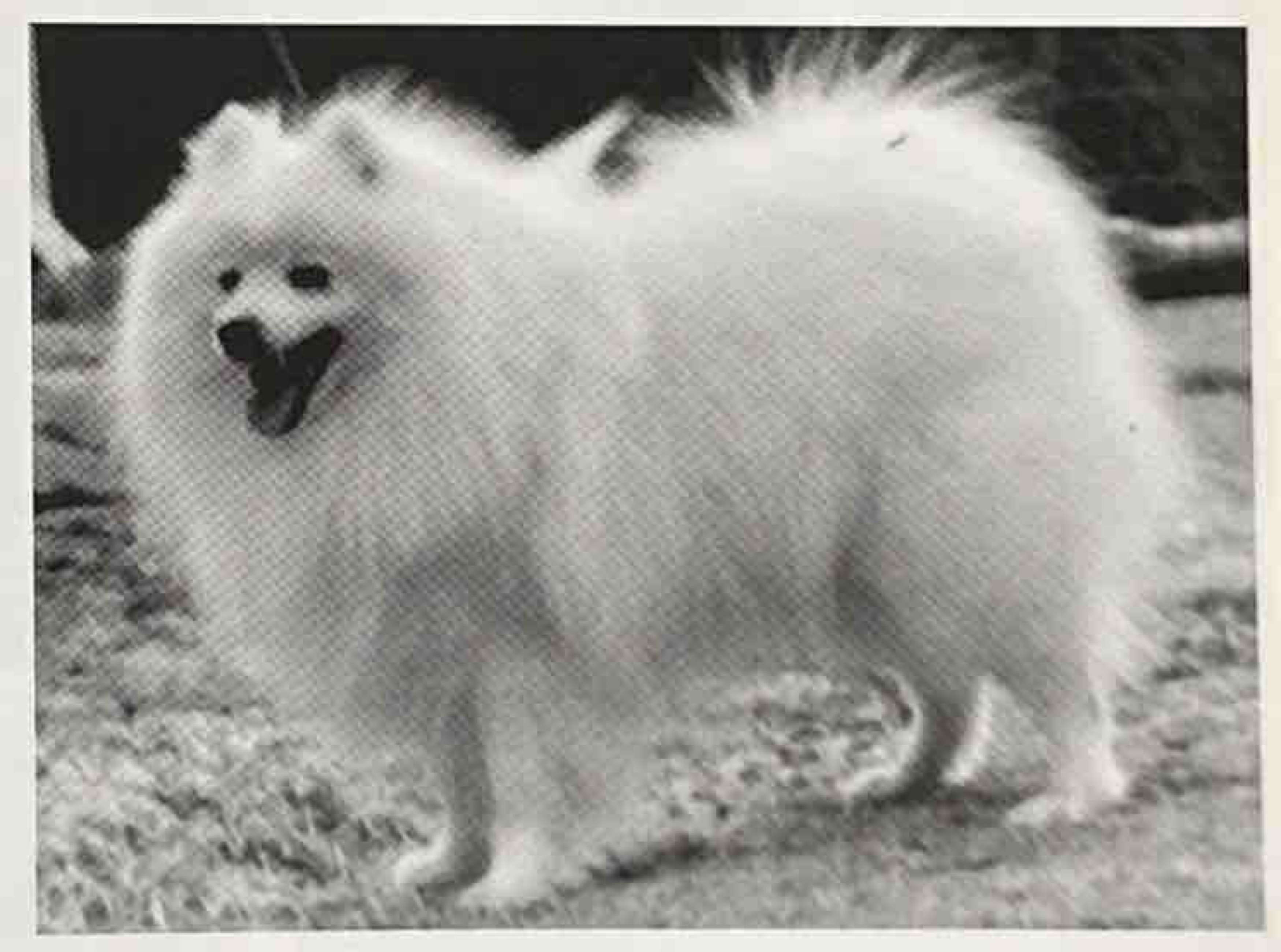
In [2], Mr. Rule refers to the picture with the caption: “№.1 Hakuryu-go, born in 1947, was the first Japanese Spitz registered by the Japan Kennel Club.” Despite its significance, this remarkable illustration doesn’t seem to have attracted much attention. Yet, it offers insights, into this dog.

The icing on the cake. Let’s imagine what Hakuryū looks like in the photo. A little AI magic and voila

What do you think?
First of all, let’s take a look at the dog. We’re curious about the majestic appearance of the Japanese Spitz we’re familiar with. Instead, we see a small, solid-shaped dog that looks quite different from today’s Japanese Spitz. This dog appears longer than the typical 10:11 proportions. It has a moderately long coat. The body is more solid than what we’re used to. It’s fascinating to see how this appearance has transformed over the years in his descendants.
Hakuryū Lineage
Now, let’s translate the text. I’ve extracted it from the picture as accurately as possible.
| ス ピ ソ ツ 犬 種牡 の No. 1 霞ヶ浦 湖 畔土 浦 に 現る! |
白龍號 第209號 |
父 | 駒號 | 祖父 | AENO直績入火 |
| 祖団 | ベ 口號 | ||
母 | 真珠號 | 祖父 | ホワイト、 フォツクス號 |
| 祖団 | テル、既 |
The top of this advertisement suggests Spitz № 1 is located by the shores of Lake Kasumigaura in Tsuchiura. Lake Kasumigaura (霞浦 湖 畔土 浦 に 現る) is the second-largest lake in Japan. It is located 60 km to the north-east of Tokyo.

But let’s back to our picture. Over the image, we see the superscription: 白龍號 第209號. This can be translated as 白龍號 (Hakuryū-go) which means “White Dragon” and 第209号 – “No. 209.” whatever it means.
Most interesting information follows. It is 血 統 – pedigree/lineage and allows us to look beyond the bounds of official stud book.
Translating dog names can be quite challenging, especially when converting from hieroglyphics—accuracy isn’t always guaranteed. I’ve managed to produce a translation as best as I could, though I hope that one day someone with more skill in Japanese might review and refine this text:
Sir | Koma (Pony/Foal) | grand-sir | AENO Choku Isao nyū hi |
| grand-dam | Be Kuchi | ||
Dam | Shinju (Perl) | grand-sir | Howaito, Fotsukusu |
| grand-dam | Teru-ki |
Lyrical digression. What does the suffix 号 (號) mean when it’s attached to animal names?
Main difficulty in research of all documents is match dog names, often we can see different spellingы the same name. Let’s dive little bit to reason.
In the east, people commonly use this suffix for domestic animals like dogs and horses, and similarly for ships. In Korea, they use it to denote individual units in buildings. They label apartments as 1ho (#1), 2ho, 3ho, etc. For example, some refer to the Titanic as “Titanic ho.” Both 號 and 号 are Chinese characters with the same pronunciation and meaning, but their usage differs regionally. In China and Taiwan, 號 primarily signifies numbers, while 号 is the Japanese adaptation of the character. The main difference lies in the regional and cultural usage of these characters. The character 號 used here is the Chinese version. It is not the Japanese version, as seen in later pedigrees – 号.
We will see this suffix from time to time in our following articles. It is important to understand that ~号(號) appears to be used when an animal’s name is formally registered. This occurs with show dogs or working animals like police dogs. This registered name may not be the animal’s everyday name. It is similar to how show dogs in English often have a registered name and a separate “call name.” There isn’t a direct translation in English. Registered names don’t typically have a suffix. Often, the call name is a shorter version or a reference to the registered name.
Special thanks to Songheon Kim (Kissablanc Kennel) for put me in right direction about this suffix.
Wikipedia’s disambiguation page for 号 says:
ウマ、イヌなど、動物の名前につける接尾辞。
What qualities were most valued during at beginning?
As it is advertising it includes a description of most valuable features of this dog. Let’s examine this to understand what qualities were most valued during that period:
| 1. 释放出,强大的性能滿點 2. 続賀健、ジステンバーに抵抗力強し 3. 食事小食、粗食に耐ゆ 4. 朝夕の特別なる運動要せず 5. 外 にして愛玩載の直火なり◎目下営支部に於て優秀牝犬に炎中・・・・ ◎仔犬分譲希望者は當支部に御照合を行ふ ◎交配希望者は常に完備せる犬舎あり山 平 觀 员 氏 愛 犬 |
- Consistently healthy with strong resistance
- Consumes small meals and can handle coarse food
- Requires no special exercise in the morning and evening
- Naturally playful behaivior
Extra Notes:
- Now, an excellent female dog is in the kennel’s spotlight.
- Those interested in acquiring puppies should inquire at this kennel.
- The kennel is fully equipped for those wishing to arrange matings.
At the bottom, there is interesting information. It is noteworthy that the name 山本號 员氏 愛 犬 can be translated as “Mr./Ms. Yamamoto’s beloved dog,” which differs from the information we saw in [1].
Disclaimer: I did the best to put together this information but you need to understand that. Translating old or classical Japanese requires careful consideration of historical context and usage. Without specific training in classical Japanese, some nuances still be lost or misinterpreted.
Next known Japanese spitz after Hakuryū-go
- Hakuo-gō (白王号, White King), whelped in 1951.
- King of Kinsen, whelped June 28, 1951;
- Rurshey of Musashiland, whelped February 2, 1953 and
- Lucky of Shinko-Saw, whelped July 5, 1953.