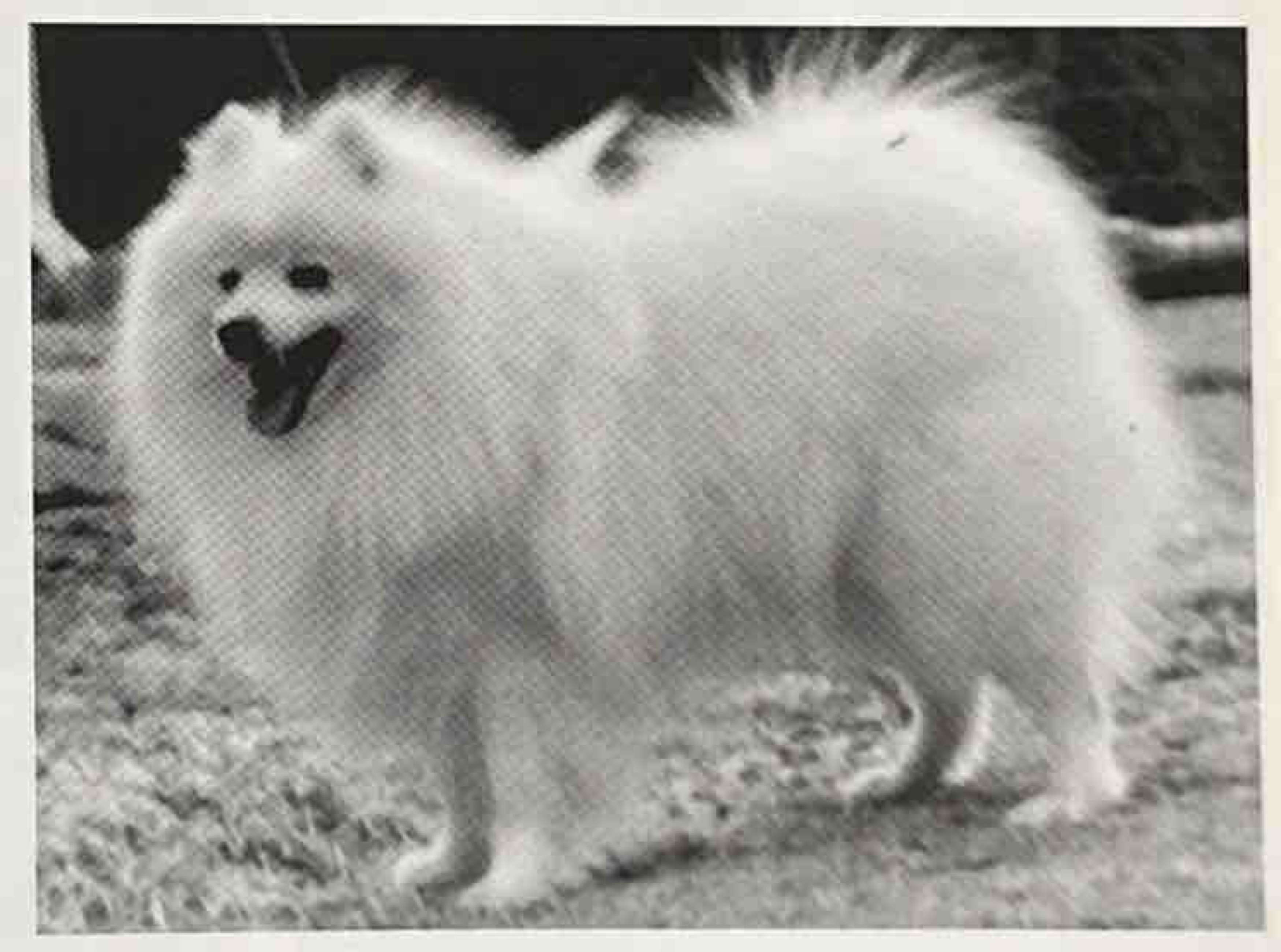
Look at spitz from old flyer below. As I continue researching the early roots of the Japanese Spitz, I would like to share a small but intriguing archival reference — an advertisement dated 1939.
At its centre is a dog named SILVER PRINCE (シルバーブリンス)

Gender: Male
Breed: unknown
Origin country: unknown
Birthday: unknown
Breeder: unknown
Owner: unknown
Very little is stated explicitly about this spitz from old flyer. His breeder, owner, and exact origin are not given, and even his date of birth remains unknown. The breed itself is not formally identified. And yet, the advertisement presents him in a very specific way — as a “superior imported Spitz breed.”
That single phrase immediately raises a number of questions.
If he was described as imported, what exactly was he? A German Spitz? A white Spitz of another European line? And, perhaps more importantly, how early did such dogs begin to circulate in Japan in a recognisable and valued form?
Given that Silver Prince must have been born before 1936, it is difficult not to consider whether he could have belonged to the group of early imported dogs that later contributed — directly or indirectly — to the formation of what would become known as the Japanese Spitz.
The advertisement does not give us a pedigree. But it does give us something equally telling: a record of success.
Silver Prince is presented as a decorated exhibition dog, with a series of notable awards across major events. In Shōwa 13 (1938), he received the Highest Distinguished Honour Award at the Ueno National Defense Exposition. The following year, on 14 May 1939, he was awarded the Highest Prize and Excellence Cup at the Dai-Nippon Aikoku Grand Exhibition, and shortly after, on 21 May 1939, he took First Place Excellent Award and Excellence Cup at the All-Japan General Livestock Grand Exhibition.
This is not the profile of an incidental dog.
Even without formal pedigree information, the language of the advertisement and the level of recognition suggest that Silver Prince was already positioned within an emerging exhibition and valuation system for spitz-type dogs in Japan before the war.
And that, perhaps, is the most important part.
These small archival fragments do not give us definitive answers. They do not yet allow us to place Silver Prince securely within a documented lineage or to state his exact role in breed development.
But they do something just as valuable.
They show that, by the late 1930s, dogs of this type were already being imported, exhibited, named, and awarded — visible enough to leave traces like this behind.
And sometimes, in research like this, it is precisely these fragments — incomplete, slightly ambiguous, but undeniably real — that open the most interesting lines of inquiry.


One response to “Silver Prince – The spitz from old flyer”
[…] clue to Silver Prince’s identity. In a separate advertisement dated Shōwa 14 (1939), a dog named Silver Prince is described as a superior imported Spitz breed, a male aged 2 years and 6 months, with a pure […]