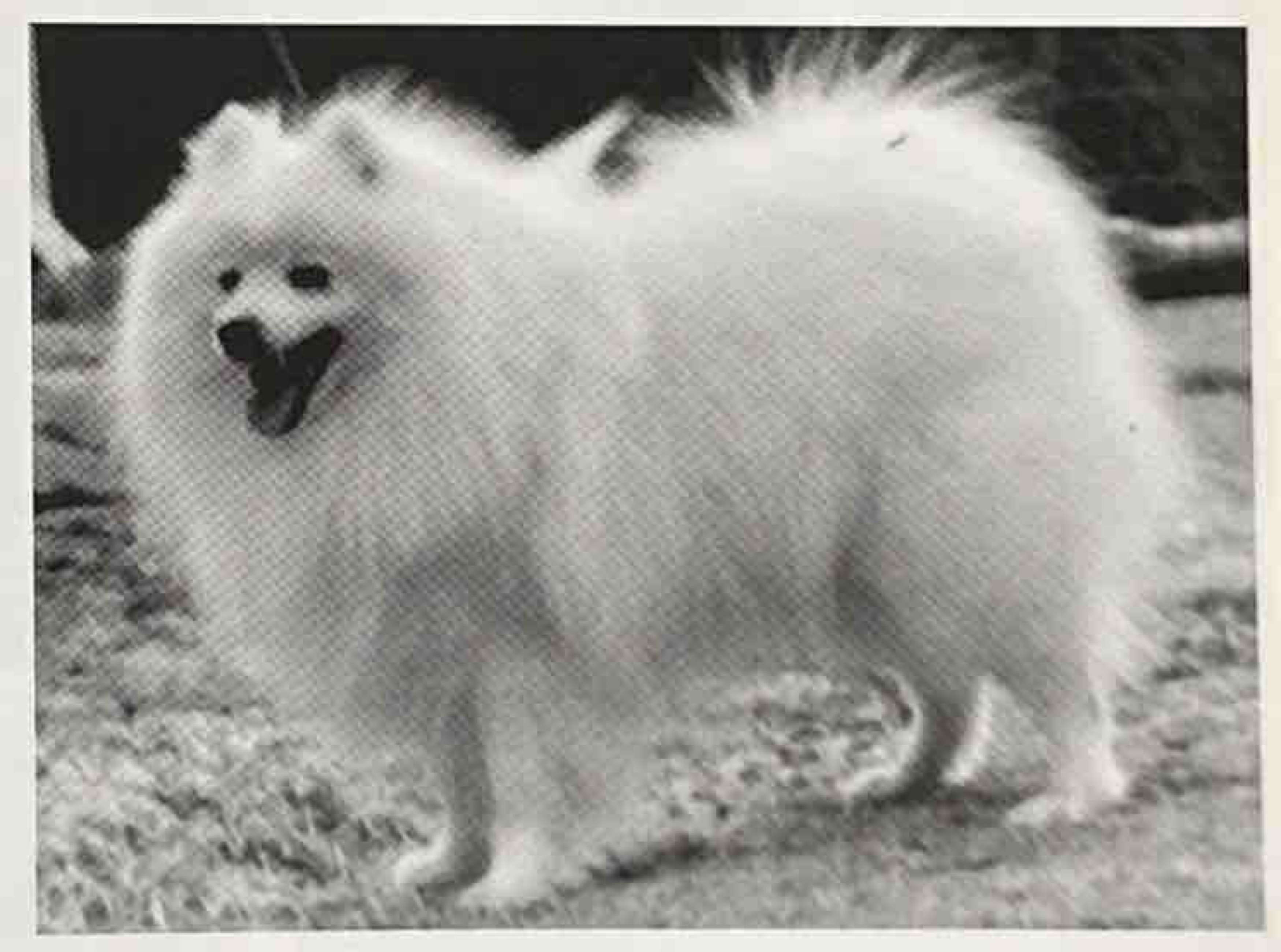
Sharing a little gem — a Japanese Spitz evaluation scoring system from way back in 1956, put together by Sakiko Inoue of the Japan Spitz Club.
It’s delightfully tidy and practical. You see a checklist that doesn’t just pick apart the dog’s bits and pieces, but already asks the judge to consider how the dog lives in its body as a whole. Which, to be honest, feels refreshingly grounded.

There’s something quietly charming about flipping through this kind of old-school wisdom. You can almost hear the conversations behind it — what mattered then, what changed, and what still makes sense.
And I can’t help but wonder…
Maybe this vintage Spitz Evaluation Scoring system had something a little more whole-breed about it?
| Evaluation Category (1956) | Points | FCI Standard (1999) | Evaluation Criteria (1956) |
|---|---|---|---|
| The ratio of body height and length | 2 | IMPORTANT PROPORTION : The ratio of height at withers to length of body is 10 : 11. | It is desired t a small difference in reach |
| Size | 3 | Height at withers : Dogs 30-38 cm. Bitches slightly smaller than dogs. | Within standard range |
| Gait | 4 | GAIT/MOVEMENT : Quick and active. | Side-walking “crabbing”, irregular gait (uneven stride, pacing, etc.), lack of activity, abnormal posture (could be structural e.g. cow hocks) and etc. |
| Coat color | 3 | COLOUR : Pure white. | The overall colour, gloss, lemon, and the presence or absence of biscuits |
| Coat quality | 10 | HAIR : Outer coat straight and stand-off. Undercoat short, soft and dense. The foreface, ears, front of forearms and part below hocks are short haired, and the rest covered with abundant long coat, especially from neck to shoulders and forechest covered with beautiful frill, and the tail also has long profuse feathering. | Hard and soft hair, length, thickness, curly hair, wavy hair |
| Tail | 4 | TAIL : Set on high, moderately long, carried over back. | Tail curl, carriage |
| Toe | 4 | FEET : Cat-feet. Pads thick, and desirably black as well as the nails. | shape and tightening method |
| Fore & hind limbs | 10 | LIMBS FOREQUARTERS : General appearance : Shoulders well sloping, forearms straight, elbows tight. HINDQUARTERS : General appearance : Muscular, stifle and hock moderately bent. | Outside the elbow, length, limb posture, knee joint strength, The sense of quantity, the good or bad of the flying knot |
| Body Chest (3) Ribs (3) Topline (4) | 10 | BODY :Withers : High.Loins : Broad.Belly : Well tucked up.Chest : Wide and deep, ribs well sprung.Back : Straight and short. | Chest depth, firmness. Ribs luck, weakness, wide and narrow chest. Convex Topline / concave Topline |
| Shoulders | 4 | Shoulders well sloping | Shoulder slope |
| Neck | 3 | NECK : Moderately long, muscles well developed. | Inclination, sense of competence |
| Muzzle (including teeth) | 10 | Muzzle : Pointed, the tip slightly round, and well balanced. Lips tight and preferably black. Jaws/Teeth : Teeth white and strong with scissor bite. | Correct bite, Dentition, missing teeth, supernumerary teeth, occlusionSize, type (thick or thin) upper shot, lower shot, long teeth excess teeth, |
| Nose | 5 | Nose : Small, round and black. | Pigmentation, type |
| Eyes | 5 | Eyes : Moderately large, almond-shaped, set slightly oblique, dark in colour. Black eyerims. | Colour, position, convex, type |
| Ears | 5 | Ears : Set on high, small, triangular, pricked, facing forward, and not too far apart. | Set, size |
| Head | 5 | HEAD : Size in balance to body, moderately broad and rounded. CRANIAL REGION :Skull : Forehead moderately developed. Rear part of skull broadest.Stop : Defined.(The foreface, ears, front of forearms and part below hocks are short haired?) | Apple-shaped head, “Zukin”/頭巾 (head covering, like a hood, around head, ears, cheeks) |
| Expression and Behavior | 3 | BEHAVIOUR / TEMPERAMENT : Intelligent, cheerful, keen in sense. Noisy not permitted. | |
| General appearance | 10 | GENERAL APPEARANCE : Covered with profuse pure white coat, with pointed muzzle, triangular pricked ears, and feathering tail over back. The constitution tough and the whole well balanced, its harmonious beauty causing spirit and dignity peculiar to this breed, and expressing elegance. | |
| Total | 100 |
Reference
Spitz Handbook. Tokyo: Seibundo Shinkosha Co., Ltd, 1955–1960. It is a foundational guide offers insight into mid-century breed standards. It also covers popular practices.