A cream-coloured dog from Sydney who helped shape a distinctly Japanese breed
Understanding Japanese Spitz origins requires looking beyond Japan’s borders. In the 1930s, spitz-type dogs arrived from Europe, North America, and — as emerging research suggests — Australia.
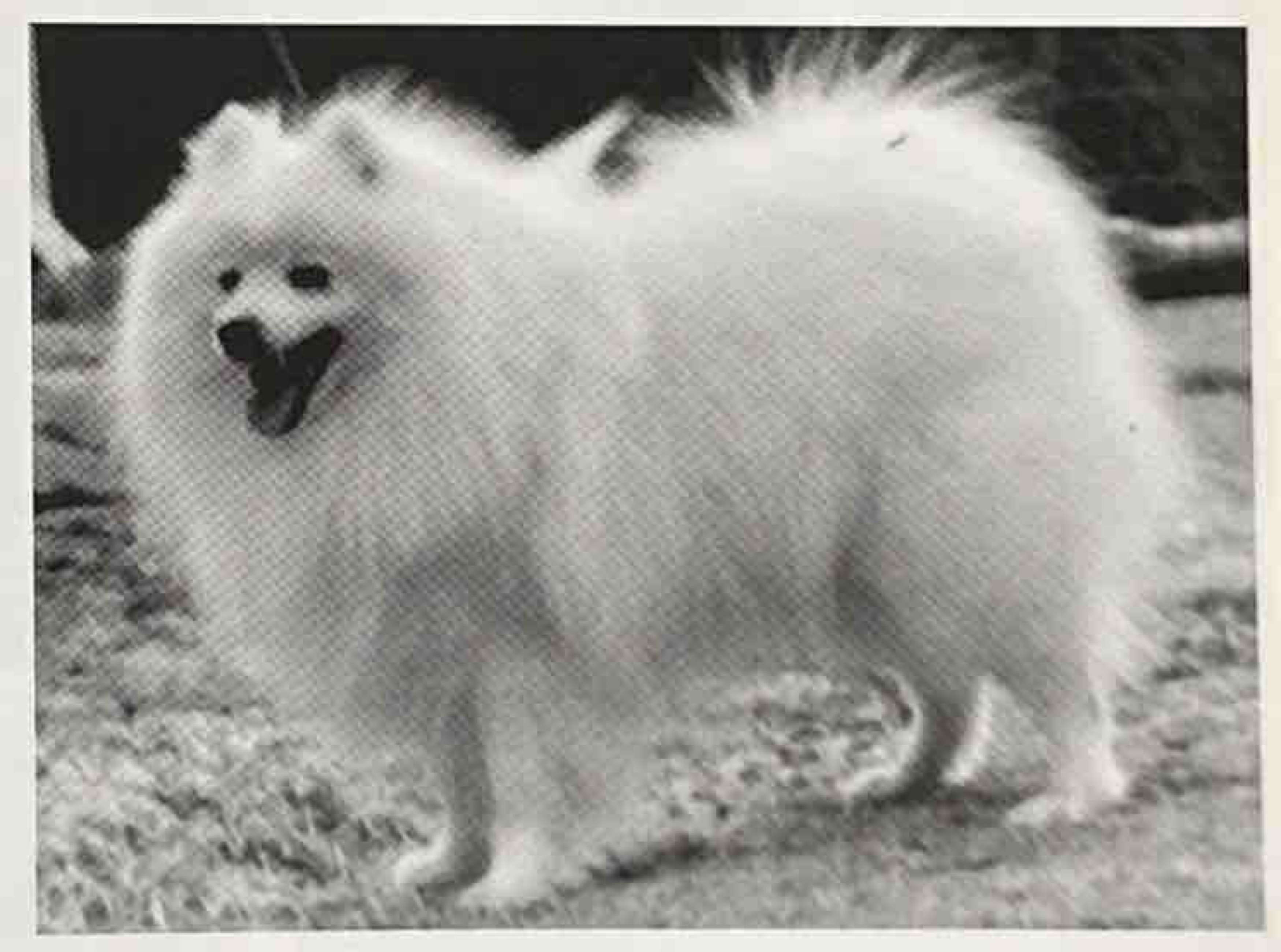
Rally Maxwell Sidny (ラリー・マックスウエル・シドニー) is one such figure. Not technically a Japanese Spitz himself, his name appears repeatedly in early breed documentation as a significant predecessor. His full name, with “Sidny” (Sydney) embedded within it, hints at an origin story that spans continents.

When I first encountered this flyer in a Japanese archive source it aroused my curiosity. When I saw photo of this dog second time in Miwako Okada’s Spitz Bible (スピッツ バイブル), I knew I had found a thread worth pulling. What emerged is a story that spans continents, survives only in fragments, and raises questions I am still working to answer.
The Australian Route
During the pre-war period, foreign dog breeds entered Japan through several channels. Pet shops such as Nichinan Shokai (日南商会) in Kobe’s Motomachi district served as key importers. Traders like Roshan (ロシャン), operated by Maeno Hajime (前野一) in Osaka, also facilitated these exchanges.
Beyond formal trade networks, foreign passenger and cargo ships—including vessels from the French MM Line—regularly arrived at Yokohama and Kobe. Sailors aboard these ships are believed to have brought numerous foreign dog breeds into the country.
Of particular significance to Rally’s story, Osaka Shosen (大阪商船) maintained regular shipping routes between Japan and Australia’s eastern ports—Sydney and Melbourne. It is through one of these routes that Rally is believed to have made his journey to Japan.
A Dog Named for His Origins
Rally Maxwell Sidny arrived in Japan around March 1936, approximately eight months old. His full name—with “Sidny” (Sydney) embedded within it—speaks to his Australian origins. A trading merchant working in Yokohama (whose name has unfortunately been lost to history) passed the young dog via Ōmori Hakkei (大森八景) to Mr. Yoshio Kurita (栗田義雄氏) in Kyoto.
What do we know of Rally himself? He was small, weighing approximately 6 kg. His coat was dense and full, though cream rather than the pure white that would later define the Japanese Spitz standard. Mr. Kurita kept Rally privately for about a year before introducing him to the show circuit.
A Brief but Brilliant Career
Rally’s public debut came in spring 1937, and his impact was immediate:
April 11, 1937 — At the 8th All-Network Machinery Art Exhibition, Rally received both the High-Positioned Award and the Comprehensive Best Companion Dog Cup.
May 15, 1937 — At an event hosted by the Tokyo Prefecture Livestock Merchant Association during the Great Japan Music Industry Comprehensive Exhibition, he received the Highest Honorable Mention and was awarded the Hōchi Shimbun Cup.
An advertisement from this period—published by Mr. Kobayashi Ken (小林県氏) of Tokyo, who acquired Rally after extensive negotiations—describes him as “the treasured dog of Mr. Yoshio Kurita and the luminary of the Kyoto small companion dog world.” The advertisement notes that Rally’s offspring were “highly coveted by owners” due to their exceptional quality.
The Trail Goes Cold
Approximately a year and a half after his show successes, Rally was transferred to Dr. Mizuno (水野医師) in Nagano. Sadly, he passed away about a year later.
But Rally’s influence did not end with his death. His lineage was preserved through his grandson, Ranger (レンジャー), who was said to be purer white with an even more profuse coat than his grandfather. Ranger reportedly won shows for three consecutive years and survived the destruction of the war years.
Then, in 1946 (Shōwa 21), Ranger disappeared.
With him vanished the direct line connecting Rally Maxwell Sidny to the developing Japanese Spitz breed—a line that had survived bombs and scarcity, only to be lost in the chaos of post-war reconstruction.
Questions That Remain
I must acknowledge the limitations of this research. My command of Japanese remains imperfect, and I have encountered discrepancies between sources that I cannot yet reconcile. Was Rally sold to Mr. Kobayashi in Tokyo or transferred to Dr. Mizuno in Nagano? The timeline suggests these may have been sequential rather than alternative destinations, but I cannot be certain.
What was Rally’s exact breeding? The sources describe him as a predecessor to the Japanese Spitz, but his cream colouration and Australian origins place him outside what we would now recognise as the breed standard. Was he perhaps a German Spitz variant from Australia? A Pomeranian derivative? Or something else entirely?
These questions continue to puzzle me. I share them here not as conclusions but as invitations—hoping that others with access to pre-war Japanese kennel records, Australian shipping manifests, or breed documentation might help illuminate what remains obscured.
The story of Rally Maxwell Sidny reminds us that breed histories are rarely as clean as registries suggest. They are built from dogs who crossed oceans in ship holds, changed hands through networks of merchants and enthusiasts, and left their mark in offspring whose photographs we can still study today.
If you have information about Rally Maxwell Sidny, Ranger, or pre-war spitz-type dogs in Japan or Australia, I would welcome correspondence through the Japanese Spitz Foundation.
Sources:
- Okada, Miwako. Spitz Bible (スピッツ バイブル)
- Historical advertisement, Mr. Kobayashi Ken, c. 1937