Junior Dandy as a remembrance of early days of Japanese Spitz
Who Was Junior Dandy?
When you spend enough time leafing through old Japanese Spitz books, something curious happens. You stop reacting to the dramatic dogs and start pausing for the quiet ones. That’s exactly what happened with Junior Dandy (Junior Dandy-gō). Not because he leaps off the page. But because he settles it.
And somewhere along the way, another thought creeps in. There is surprisingly little hard evidence of how many of those early dogs truly looked. A handful of photographs. A few written notes. And yet, despite that, you begin to recognise them.
Not through documents but through living dogs.
Every now and then, you look at a modern Japanese Spitz and feel an odd sense of familiarity. The outline, the expression, the way the dog holds itself. No direct pedigree link you can point to, no neat line on paper and yet the resemblance is unmistakable. Almost like meeting a twin you weren’t expecting.
It’s one of those quiet genetic moments that remind you how inheritance really works. Not as a straight line, but as echoes — carried forward, reshuffled, and suddenly visible again decades later.
And standing there in the book, Junior Dandy-gō feels like one of those echoes made visible.

Gender: Male
Breed: Japanese Spitz
Origin country: Japan
Birthday: June 26, 1953
Junior Dandy Pedigree
Sire: Tahiro of Mistcape
Dam: Baby
We only know he achieved notable success in the show ring, becoming a winner at the 1956 International Champion Show, and earning the title of Reserve Champion, along with the Minister of Foreign Affairs Prize. These are respectable credentials but they only tell part of the story.
A Compact and Well-Filled Early Japanese Spitz Type
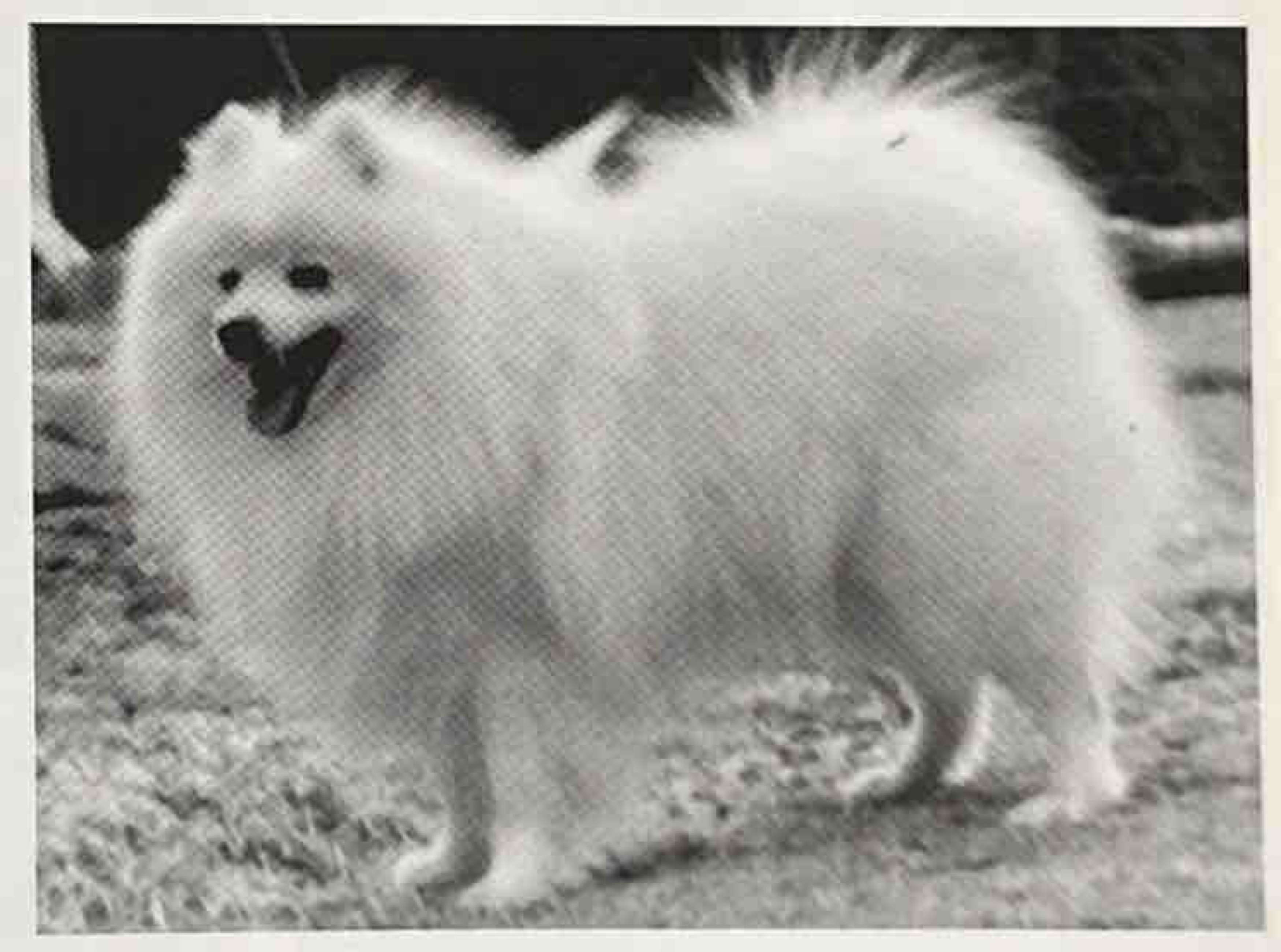
What stands out immediately in Junior Dandy’s photograph is how complete he looks. There is no stretch. No lightness. No sense of a dog trying to be more than he is.
His outline is compact and well filled, with good body depth and a stable, square impression. The ribcage and loin feel solid, giving him a grounded presence, the kind of body that carries coat comfortably rather than fighting it.
This is a dog built to last, not to impress for a moment.
Structure and Bone: Strength Without Heaviness
Junior Dandy shows moderate to strong bone, evenly distributed throughout the body. His forelegs are firm, the pasterns well supported, and the feet appear compact and functional.
There is no visual fragility here, but equally, no coarseness. Everything feels measured, calm, and settled. This balance is one of the defining features of his type.
Head and Expression: Masculine, Gentle, and Thoughtful
The head is masculine without being heavy or coarse. Skull and muzzle are well balanced, producing an expression that feels composed rather than intense.
What truly defines his look, however, is the expression.
His eyes appear ginkgo-nut shaped — softer, rounder, and more thoughtful than sharp. This gives him a slightly cheeky, good-natured look, far removed from edgy alertness. It’s an expression you trust instinctively.
The ears are upright, triangular, and cleanly set, completing a classical Spitz head without exaggeration.
Coat and Tail: Density Without Disguise
Junior Dandy carries a full, dense coat, particularly around the neck, shoulders, and body. The frill is rounded and well developed, framing the front without breaking the outline. Importantly, the coat never hides the dog.
You can still read the structure beneath it. The texture appears supportive and firm rather than airy or loose.
His tail plume is full and confidently carried over the back, reinforcing a strong, stable topline silhouette.
Presence and Overall Impression
Junior Dandy doesn’t feel flashy. He just catch attention by quiet confidence and stability. His posture suggests a dog comfortable in his own body. No tension, no looseness, no exaggeration. Just balance.
This kind of dog explains his own success without needing commentary. When you encounter him in old records, you understand immediately why he did well and why he was trusted.
Why Junior Dandy-gō Matters in Japanese Spitz History
When studying early Japanese Spitz males of the 1950s, Junior Dandy fits naturally into a group of dogs defined by compactness, substance, and calm balance, a type that contrasts clearly with lighter, more elongated or sharper-outlined males seen elsewhere in the same period.
Without being dramatic, he represents something important: a reliable, settled expression of early breed ideals. He doesn’t shout from history. He simply sits there — convincing.
And sometimes, that’s exactly the kind of dog worth stopping for.
References
- Spitz Handbook. Tokyo: Seibundo Shinkosha Co., Ltd, 1955–1960. It is a foundational guide offers insight into mid-century breed standards. It also covers popular practices.