from memories of Nikolai Karpovich Pavlenko
Introduction
Nikolai Pavlenko was born on November 21, 1943, in Severodonetsk, Ukraine. At the age of 17, he began working in a zoo circus, starting as an animal caretaker, then as a guide-lecturer, head of a section, and eventually becoming the director of the zoo circus. Later, he transitioned to becoming an animal trainer. In 1963, Pavlenko graduated from the Moscow Zootechnical Institute with a degree in animal husbandry. His career began with working alongside an elephant, but soon he expanded to working with dingoes, wolves, brown and polar bears, llamas, camels, jaguars, horses, and panthers.

In 1972, the young Pavlenko was assigned as an apprentice in an attraction led by Alexander Nikolaevich Alexandrov-Fedotov. A year later, Pavlenko made his debut with Alexandrov-Fedotov’s tiger act at the Lviv Circus. Initially, the act featured eight predators. By the mid-1980s, Pavlenko was working with two types of tigers: Amur and Sumatran. Eventually, he decided to focus exclusively on Sumatran tigers.
In the early 1990s, Pavlenko prepared an act featuring the largest group of Sumatran tigers in Russian circus history—17 in total. One of the most striking tricks in his act involved two enraged tigers “attacking” the trainer, who, with a firm command, would stop their aggression, forcing them to rise on their hind legs and retreat all the way to the enclosure fence.
A key indicator of a predator’s well-being in captivity is its ability to reproduce. For Pavlenko, a recipient of the State Prize, his Sumatran tigers consistently gave birth to dozens of cubs every year. His tigers lived in excellent conditions—well-fed, groomed, and spirited in the ring, displaying energy and enthusiasm during performances.
How It All Began: Odorikko von der Hausruckhohe (Rikki)

I grew up in the Donbass region of Ukraine, a place with a rich history. During the reign of Catherine the Great, German industrialists settled in the area, bringing with them their customs, traditions, and, of course, their animals. Among these were dogs, including the beloved Spitz, a breed the Germans had a special affection for. As a result, Spitz-type dogs were a common sight in Donbass and other developing regions. I was surrounded by them from a young age, and they quickly became a part of my life, sparking my lifelong love for the breed.
In 1955, I encountered my first purebred white Spitz. These beautiful dogs had been imported from Leningrad, and from the moment I saw them, I was captivated. This was the post-war era, a time of the Iron Curtain, and outside of the German Shepherd, which I greatly admired, there were few other breeds visible to us in Donbass. Even in Moscow and Leningrad, little attention was given to decorative dogs, with military-focused organizations like DOSAAF overshadowing everything.
In 1962, I acquired a Bolognese for my work with an elephant, training her to walk on her hind legs and perform a waltz. It took several months, but when she finally mastered it, her performance was so graceful it brought tears to people’s eyes. Despite this, my heart still longed for a Spitz. A local acquaintance in Donbass had a mongrel who gave birth to a litter, and among the mixed-breed puppies, one stood out: a female that looked like a true Spitz—white with yellow patches. I took her in and named her Alma. Alma grew into a magnificent dog, intelligent and devoted, and her love for me was unmatched. She was also incredibly easy to train.
Fast forward to 1977, while I was on tour in East Germany. Knowing that both Shepherds and Spitzes had their roots there, I decided it was the perfect opportunity to bring back a Spitz. I wanted a large, non-white one, and I was advised to seek out a Wolfspitz. I managed to bring back a pair of Wolfs. The female lived for 10 years before succumbing to diabetes, while the male lived until 1995.
By 1993, I had decided to incorporate dogs into my performances. Throughout my life, I had worked with wild animals. While many of them were affectionate towards me, they were still wild, and I wanted something different for this act. At the time, my Wolf Spitz was old, and I knew I needed a change. Despite my deep admiration for the Wolfspitz, I realized that only a white Spitz would suit my needs—and such a dog did not exist.
With the help of Britta Ecklmayr, an expert on Spitz breeds from Austria and Germany, I learned that in the 1930s, there had been a rare occurrence of white Wolfspitz in the United States, but they had been quickly bred out. I still wanted a white Gross Spitz, and after searching for several years, Britta suggested I look into medium-sized white Spitzes. I had little luck finding breeders in Germany, but there was a kennel in Austria called “von der Hausruckhohe,” owned by Britta herself.
Britta, who later married and took the surname Schweikl-Ecklmayr, mentioned that the Spitz she had was Japanese. I didn’t think much of it at the time. With the help of a circus colleague in Munich, arrangements were made for Britta to bring the puppy there, as I couldn’t travel to Austria due to visa issues.
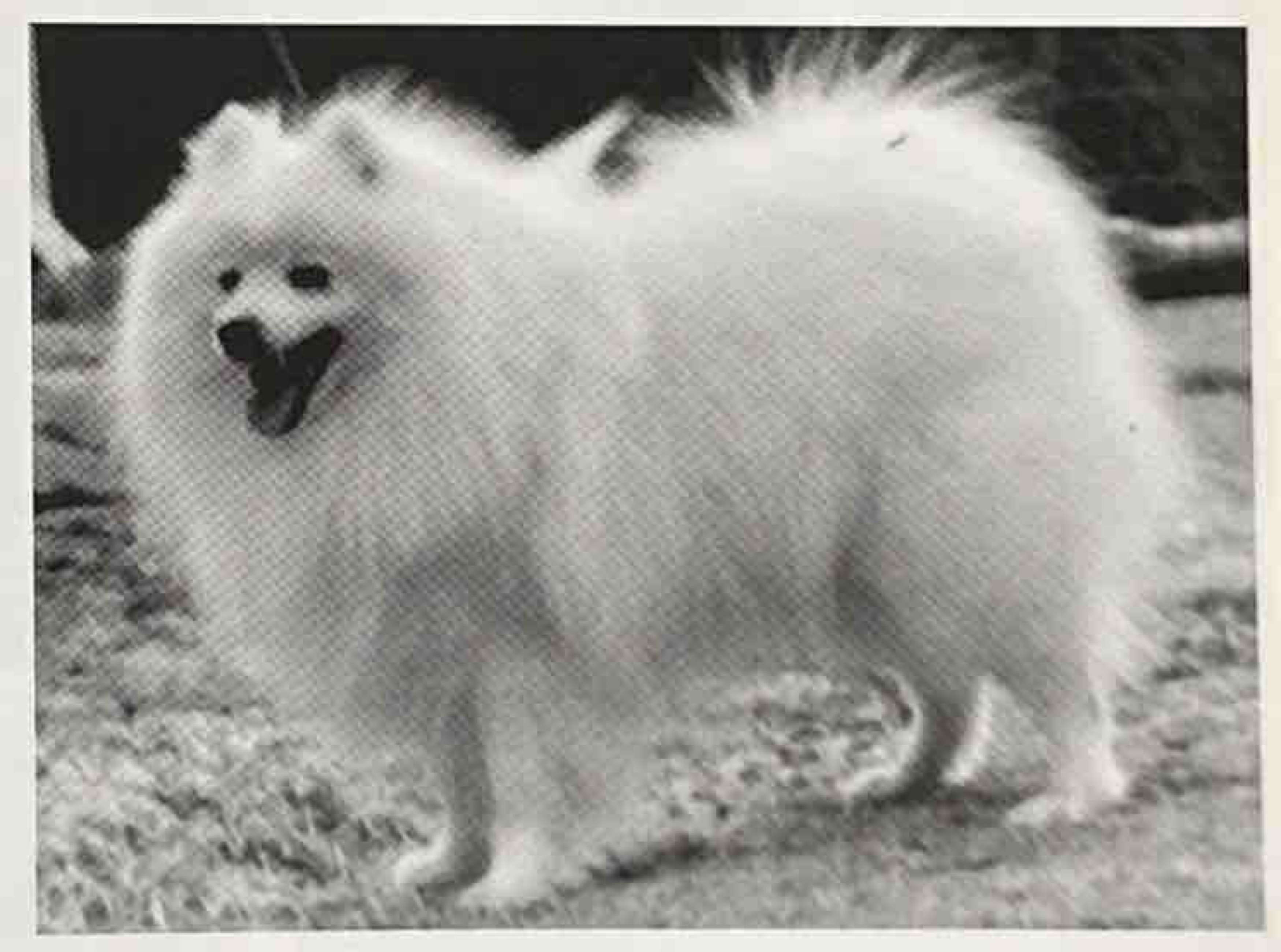
I was nervous. I hadn’t seen the puppy, hadn’t picked her out myself—only sent a deposit. My nerves persisted until midday, when Britta finally arrived. But the moment I laid eyes on her, all my worries disappeared. I was overjoyed. The puppy was almost two months old, and her name was Odorikko von der Hausruckhohe, the daughter of Alkola Tomodachi and Yukiarashi von der Hausruckhohe.
We called her Rikki. She was my first Japanese Spitz, and from the moment she came into my life, everything changed. For the next five or six years, while she had her own children and grandchildren, I was always afraid that my happiness with her was too good to last. But it did. Rikki was unique, unlike any other dog I’ve had since. My wife often says that while we’ve loved all our dogs, Rikki was different—almost human in the way she connected with us.
Now, nearly 20 years later, Rikki’s legacy lives on. There are very few pedigrees in Russia that don’t trace back to her, though her name is often hidden behind more recent generations. She traveled with me on tours to Japan, where experts praised her, noting only her slightly large eyes.
Rikki was the first Japanese Spitz I brought back from Germany, and though I’ve had many dogs since, none have been quite like her. She remains one of the greatest joys of my life, a true companion in every sense of the word.




One response to “Untold Stories: Nikolai Pavlenko’s memories about the Japanese Spitz”
[…] owner, Nikolai Pavlenko, is known as one of the greatest tiger trainers in XX century. He shared how meeting Rikki changed […]