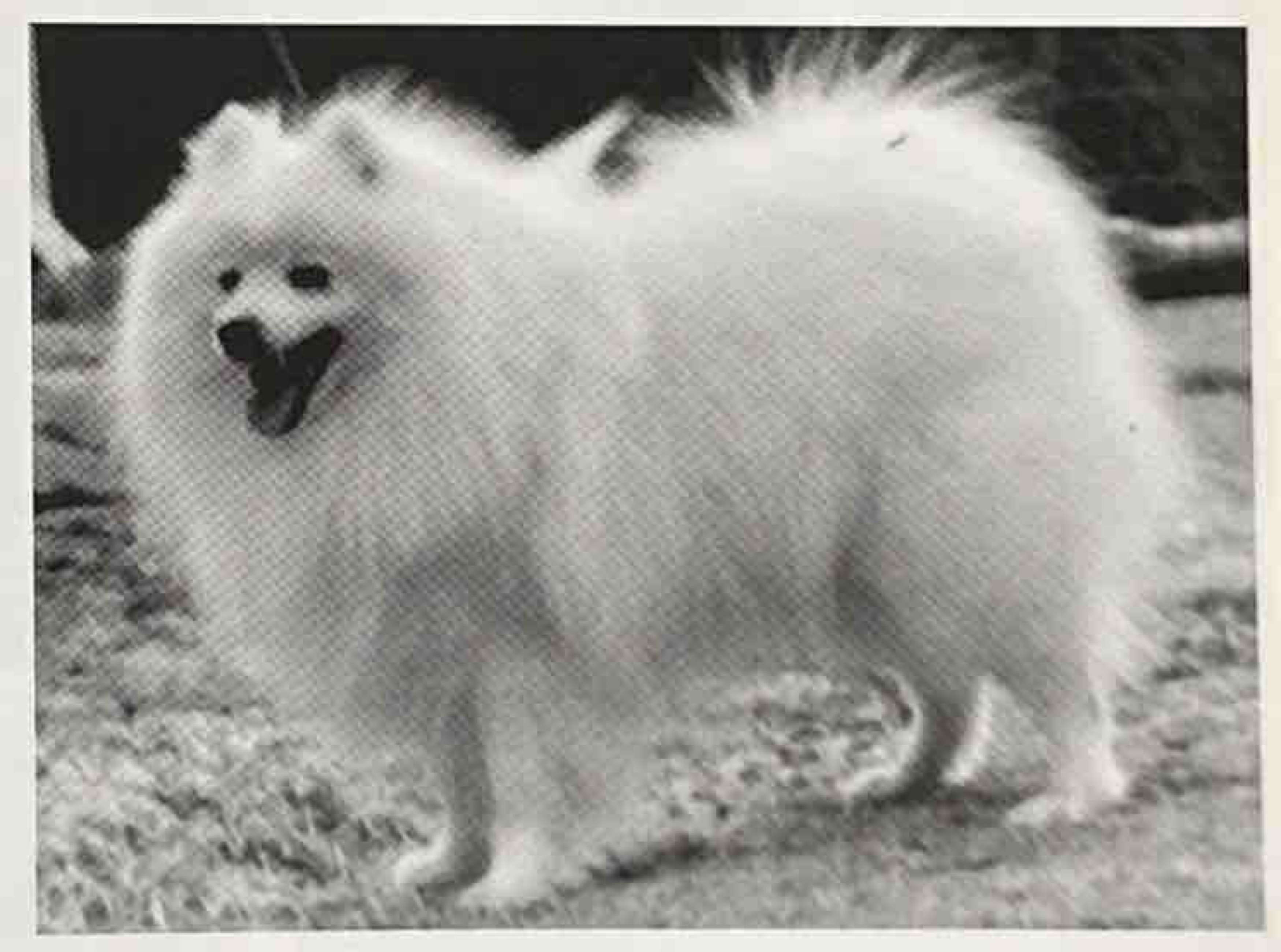
A remembrance of Velda of St. Paul
Who Was Velda of St. Paul? A Foundation Female in Japanese Spitz History
Some dogs step out of history quietly; others seem to walk toward you as if they’ve been waiting. Velda of St. Paul is one of the latter. Every time I look at her photographs — grainy, careful, unmistakably 1950s — I’m struck by the odd sensation that she already knows she will matter.

Gender: Female
Breed: Japanese Spitz
Origin country: Japan
Birthday: June 27, 1955
Breeder: Akira Nozawa
Owner: Kinroku Akiyama
Velda of St. Paul Pedigree
Sire: Hakuō-gō (Yashiro Kennel)
Dam: Lily-gō (Rokuwasow Kennel)
She was born on a warm June day in 1955, at the height of the great Japanese Spitz boom, when white dogs appeared in shop windows and families queued at breeders’ doors. But Velda wasn’t just another puppy in the rush. She carried an inheritance — the unmistakable stamp of her sire, Hakuō-gō (White King). Even before she had a name, she had a destiny written into her structure.
The Pedigree Behind Velda of St. Paul: Descendant of Hakuō-gō (White King)
Her breeder, Akira Nozawa, must have known. Her owner, Kinroku Akiyama, surely knew. And the judges learned it quickly enough: within months she was sweeping through shows, collecting Excellent ratings and first prizes as though she were simply doing what the world expected of her.
Highlights from her brief but dazzling career include:
- 1955 — JKC Autumn Headquarters Show: Excellent
- 1956 — Seibu Aiken Club: Excellent
- 1956 — International Dog Exhibition: First Prize (Excellent 1st)
- 1956 — Aiken no Tomo International: 1st Place, Gold Cup
- 1956 — Izanami Show: Reserve Champion
- 1956 — JKC Autumn Headquarters Show: Best in Show
By 1956 she stood as the first female champion the breed ever produced — the kind of quiet milestone you only recognise in hindsight, when you see how much of the future rests on one pair of paws.
Early Japanese Spitz Breeding: Velda of St. Paul’s Influence at Golden Star Kennel
And then came the children. Twenty-three of them, if we trust the surviving records. Imagine that: twenty-three puppies from a single female in a time when breeding was still finding its footing after the war. Golden Star Kennel grew around her as though she were its centre of gravity. A few of her well-known descendants:
- Arthur of Golden Star — by Gon of Kamogawa
- Edward Boyer of Golden Star — by Julian of Japan Kennel
- Clara of Golden Star — by Julian of Japan Kennel
- Flora of Golden Star — by King Light of Greenwood
These puppies became threads woven into the early tapestry of the breed.
Photographic Evidence: What Velda of St. Paul’s Images Reveal About Early Type
But the true story begins when you look at her.
In the photos she isn’t trying to impress anyone. She stands as dogs often do when they believe no one is asking anything of them — relaxed, certain, softly present. She has that refined, dry elegance the early breeders longed for: square outline, short back, just the right amount of leg. Her bone is feminine but sure of itself. Her expression is bright without sharpness. There is nothing exaggerated, nothing forced. You could remove the ribbons and titles and she would still look like the dog who shaped a breed.
Her head is my favourite part: that fox-like clarity, the gentle narrowing of the muzzle, the dark almond eyes that seem to be listening. Dogs from the 1950s often feel distant on paper, but Velda’s gaze bridges the decades. You can almost imagine her stepping out of the frame, tossing her tail once, and trotting off as if to show you how a Japanese Spitz should move.
Even the coat — straight, firm, flowing enough to catch the air — tells you who she was. No excess, no vanity. Just a dog built with thought and purpose.
What stays with me is her presence. Not dramatic, not loud. Just a quiet confidence that feels almost tender when you realise how early this was in the breed’s formation. She carried the future without knowing it, and somehow made it look effortless.
Why Velda of St. Paul Still Matters to Japanese Spitz History
When the old records call Velda of St. Paul a foundation female, they’re technically correct. But the truth is gentler and a little more human: she is one of those rare dogs who leaves a shape in the history of a breed — a silhouette other dogs unconsciously grow toward.
And when you look at her photographs, decades later, you feel it.
You feel the beginning.
References
- Okada, Miwako. Spitz Bible. Tokyo: Seibundo Shinkosha Co., Ltd, 2023.— This work is a comprehensive reference. It compiles breed history and type development. The cultural perception of the Japanese Spitz from pre-war to modern eras is also included.
- Spitz Handbook. Tokyo: Seibundo Shinkosha Co., Ltd, 1955–1960. It is a foundational guide offers insight into mid-century breed standards. It also covers popular practices.
- Spitz album: 1979 [スピッツアルバム : 1979]. Japan Spitz Association. National Diet Library Digital Collections .