Genetic testing has become an essential tool in dog breeding. It helping breeders find carriers of hereditary diseases and make informed mating choices. For Japanese Spitz breeders, tests like PRA-rcd4 are crucial. This importance is due to the condition’s late onset. It has a potential impact on vision. Nonetheless, navigating test options requires understanding not just which tests to use, but also which laboratories are eligible for tests.
This guide outlines reliable testing options, how to choose approved laboratories, and what breeders need to know to make sure results are both valid and verifiable.
Understanding Global Standards and Oversight in Genetic Testing for Japanese Spitz
Progressive Retinal Atrophy (PRA), particularly the rod-cone degeneration 4 (rcd4) variant, is a late-onset hereditary eye disease. It can affect Japanese Spitz. While rare, its presence has been confirmed in several lines. Proactive DNA testing helps prevent producing affected puppies while maintaining genetic diversity.
First of all, we need to understand that as of 2025, no single global authority regulates DNA tests for dogs. This means breeders, veterinarians, and kennel clubs must rely on a combination of national rules. They also depend on peer-reviewed data and breed-club guidance to assess test quality and laboratory credibility.
Founded in 1970, the International Society for Animal Genetics (ISAG) was established. It collaborates with its associated International Foundation for Animal Genetics (IFAG). These are leading global organizations that support and coordinate research. They focus on standardization in the field of animal genetics. Their work underpins much of the scientific credibility and harmonization behind DNA testing for animals—including dogs. ISAG is best known for standard marker panels. These panels are used for parentage verification and identity testing in companion and livestock animals. Most veterinary genetic laboratories are members of ISAG/IFAG. ISAG/IFAG are not regulatory bodies, but their scientific authority influences policy and best practices across veterinary genetics. Hence, it is the policy of ISAG that:
- ISAG does NOT endorse commercial products or practices.
- ISAG will NOT become involved in the accreditation of service genotyping laboratories or institutions.
- ISAG does NOT regard participation in its Comparison Tests as indicating that a lab is internationally accredited.
Veterinary geneticists and kennel clubs began discussions. They talked about the lack of global coordination in addressing inherited disorders and breed health issues. The Swedish Kennel Club (SKK) played a crucial role. They championed the initiative and incubated the idea of a global partnership. It is how IPFD was born
The International Partnership for Dogs (IPFD) is a nonprofit organization. It was founded in 2014. The mission is to improve the health, well-being, and welfare of dogs worldwide. It emerged because veterinary experts, kennel clubs, breed organizations, researchers, and breeders recognized the need for international solutions. Canine health challenges—especially genetic diseases—demand collaborative efforts. Early contributors included the Finnish Kennel Club. They also included the American Kennel Club Canine Health Foundation, Canadian Kennel Club, The Kennel Club (UK), and others. Now the International Partnership for Dogs (IPFD) acts as a global platform. It unites science, policy, and practice in canine health. DogWellNet and HGTD are flagship initiatives. They offer essential tools for breeders, researchers, and kennel clubs. These tools strive for evidence-based, ethical, and sustainable breeding decisions.
There is now no universal global oversight body specifically for dog DNA testing. This contrasts with human genomics, which is regulated by CLIA, FDA, or CE-IVD marking. Nevertheless:
- ISAG/IFAG and IPFD/HGTD is the most recognized effort to fill this gap globally.
- National Kennel Club approvals act as practical regulatory checkpoints in Europe and beyond.
Understanding Official Recognition of Genetic Test Results by FCI National Organizations
This guide outlines PRA-rcd4 testing options for breeders. These options help guarantee results are trustable. If you like the result to be recognized by your national kennel clubs – it is recommended to contact them before. Let me explain why.
As far as I know, the official databases of FCI, managed by national organizations, currently operate as follows: for genetic test results to be officially recognized and entered into a national database, several conditions must be met. In particular, it is usually required that the national breed club registers an official health program concerning a specific disease — in this case, PRA-rcd4. Alternatively, the test must be explicitly listed in the breeding regulations for the breed as a mandatory or recommended condition for breeding approval, taking into account all requirements and restrictions established by national legislation. Only if such a program exists and outline list of laboratories the results from these laboratories recognized within that system be officially entered into the national pedigree database.
At present, no such programs or requirements have been registered by the national Japanese Spitz clubs, and the question of their necessity is still under discussion.
Therefore, below I have compiled information on laboratories that have already been recognized under health programs for other breeds. This will help us prepare in case there is a future need to officially enter data. Based on this list, the national breeding committee would be able to form a list of laboratories whose results it considers acceptable.
| Laboratory | Country | Avg. Price | Turnaround | Accepted By | Link |
| Orivet DNA (Genetic Pet Care Limited) | Australia | €65 | ~2 weeks | ANKC | Orivet PRA-rcd4 test |
| FERAGEN GmbH | Austria | €49 | 5–7 days | ÖKV | FERAGEN PRA-rcd4 test |
| Genomia s.r.o. | Czech Republic | €60 | 7–10 days | SKK, DKK, KC, VDH, ZKwP | Genomia PRA-rcd4 test |
| GenoCan s.r.o | Czech Republic | €49 | ~7–10 days | – | GenoCan PRA-rcd4 test |
| MOVET / IDEXX LABORATORIES OY | Finland | €120,61 | ~1 week | FKK | Movet Oy PRA-rcd4 test, Form, Price |
| LABOKLIN GMBH & CO. KG | Germany | €62 | 1–3 weeks | Most European KCs | Laboklin PRA-rcd4 test |
| LABOKLIN UK GMBH & CO. KG | UK | £ 48 | 2-3 weeks | Most European KCs | Laboklin UK PRA-rcd4 test |
| Labogen ( LABOKLIN GMBH & CO.KG) | Germany | €62 | ~2 weeks | VDH, SKK | Labogen PRA-rcd4 test, Labogen Shop |
| GENEFAST SRL | Italy | €67 | ~10 days | ENCI | Genefast PRA-rcd4 test |
| EVG, molekularna diagnostika, d.o.o. | Slovenia | €54 | 4–5 days | SKK, KZS | EVG PRA-rcd4 test |
| VHLGenetics (Dr. Van Haeringen Laboratorium BV) | Netherlands | €57 | ~7 days | DKC, ZKwP | VHL PRA-rcd4 test |
| VetGen (SIA “GENERA”) | Latvia | €59 | ~1 week | ZKwP, informal in SKK | VetGen PRA-rcd4 test |
| Animal DNA Diagnostics | UK | £42 | 3–4 weeks | KC | Animal DNA Diagnostics PRA-rcd4 test |
| The KC DNA Services | UK | €60 | ~2–3 weeks | KC | KC DNA Testing PRA-rcd4 test |
| IDEXX Laboratories Ltd | UK | – | – | KC, DKK | IDEXX PRA-rcd4 test |
And if it is important to you that the test be entered into your national FCI organization’s health database, it is always best to contact them directly. If you receive a response and are willing to share it with me, I’d be happy to update the article accordingly.
Note: According INTERNATIONAL BREEDING RULES OF THE FCI if a DNA test is performed, the identification (chip or tattoo) of the dog must be checked and certified by the veterinarian who collects the sample as is the case with any health protocol; the test result certificate from the laboratory must include the dog’s identification.
International Ordering & Breeder Considerations
Sample Type: Most genetic testing labs accept cheek swabs and/or EDTA blood. All kennel clubs require samples to be collected or verified by approved, independent, trained collectors, including veterinarians. Owners/breeders can collect from their own dogs. In this case it was stated that dog was identified by owner.
Shipping: Follow labs provided instructions. For non-EU shipping, include a customs declaration (“non-commercial animal sample”).
Results: Usually sent by email as a certificate. Valid for Kennel Club submission only if from a recognizable laboratory.
Building a Global Health Record for the Japanese Spitz
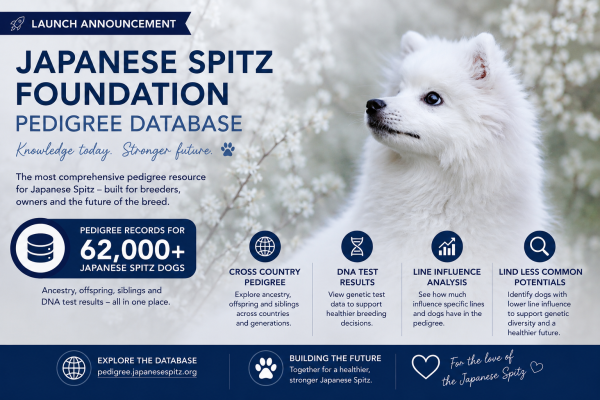
One of the long-term goals of the Japanese Spitz Foundation (JSF) is to create a centralized, breed-specific cross country pedigree and health database Japanese Spitz Pedigree Database Project that will support breeders, owners, and clubs around the world.
To make this vision possible, we are currently gathering information on how PRA-rcd4 test results are handled across different countries — including which laboratories are accepted by national FCI organizations and breed clubs. This data will form the foundation for a transparent and reliable reference system.
If you’re ready to contribute to our understanding of how PRA-rcd4 affects the Japanese Spitz breed, please consider sharing your test results through Google form Japanese Spitz PRA-rcd4 Test Results Submission. At this stage, my focus is on keeping things accurate, private, and breeder-friendly. That’s why we’re starting with a simple, accessible Google Form — a lightweight tool that allows us to see how many dogs have been tested and how many owners are open to sharing results. All submissions go into a secure Google Sheet, which can easily be reviewed or transferred to a more advanced system like Japanese Spitz Pedigree Database later.
My aim is not only to support responsible decisions today but also to lay the groundwork for future cross-border access to verified health records for Japanese Spitz dogs.
If your country has specific rules or accepted labs for test result registration, or if you’ve contacted your national kennel club, please consider sharing that information. Every piece of this puzzle brings us closer to a trusted, international breed health platform.
Together, we can ensure that the health of the Japanese Spitz is preserved — not just within individual countries, but across the world.
Conclusion for Breeders
To ensure that your PRA-rcd4 DNA test is recognized, choose a laboratory approved by your national kennel club. Be sure to follow local kennel club protocols (requisition forms, vet collection, correct submission) to register results. The good news is that PRA-rcd4 can be completely avoided in Japanese Spitz breeding. This requires thoughtful planning. Utilize kennel club-registered DNA tests and implement clear breeding strategies.
References
- Norwegian Kennel Club (NKK). Retningslinjer for registrering av DNA-testresultater i NKKs DogWeb. Norwegian Kennel Club, 2024. Procedure for DNA testing and registration in the Norwegian Kennel Club
- Norwegian Kennel Club (NKK). DNA-laboratorier, tester, raser. Last updated 2024. DNA – laboratories, tests, breeds. DNA tests where NKK registers the results centrally in the Norwegian Kennel Club’s database DogWeb
- Swedish Kennel Club (SKK). DNA-tester – Så här går det till (How DNA testing works). SKK Clinician Web. Accessed June 28, 2025. Available at: DNA test – here’s how you do it.
- Finnish Kennel Club (Kennelliitto). DNA test results are saved to the Finnish Kennel Club’s Breeding Database DNA test results are saved to the Finnish Kennel Club’s Breeding Database
- Danish Kennel Club (DKK). Godkendte laboratorier DNA-test. DKK official site. https://www.dkk.dk
- Danish Kennel Club (DKK). Godkendte laboratorier DNA test” spreadsheet (01.02.2024)
- The Kennel Club (UK). Progressive Retinal Atrophy (rcd4-PRA) – DNA Test #8435. Laboklin UK. https://www.laboklin.co.uk/laboklin/showGeneticTest.jsp?testID=8435
- Société Centrale Canine (SCC, France). Criteria for registering a genetic test
- Slovenian Kennel Club (KZS). Decisions of the Breeding Committee of the Slovenian Kennel Club (KZS)
- Slovenian Kennel Club (KZS). Update of information regarding ordering DNA profiles from EVG
- Raad van Beheer (Netherlands). Referenced via DogWellNet and https://www.combibreed.com
- ENCI (Italy). Genefast srl official test list. https://www.genefast.com
- German Kennel Club (VDH). Dealing with an Increasing Number of Canine DNA Tests
- German Kennel Club (VDH). Workshop 3 Summation: Genetic Testing
- Polish Kennel Club (ZKwP). Mandatory DNA testing for breeding
- Austrian Kennel Club (ÖKV). ÖKV DNA Testing Policy
- Austrian Kennel Club (ÖKV). Breeding requirements for ÖKV-supported breeds
- Australian National Kennel Council (ANKC). Dogs Queensland (an official state affiliate of the ANKC) lists Orivet DNA alongside Massey University in its “DNA Services” section—indicating that Orivet is one of the approved laboratories accepted for official testing, including parentage verification. See https://dogsaustralia.org.au/media/10030/6-da-reg6_registration_aug-23.pdf and https://dogsqueensland.org.au/members/dna-services/.
For updates or help coordinating group testing, contact your national breed club


One response to “PRA-rcd4: Genetic Testing Options for Japanese Spitz Breeders”
[…] EVG is not the only laboratory offering genetic testing relevant to Japanese Spitz. If you would like to compare laboratories, available tests, sample requirements and other options, see our comparison of genetic testing options for PRA-rcd4. […]